See how IT-Conductor SecureOps extends SAP Security Patch Day into continuous vulnerability assessment, remediation, and risk reduction.
SAP Security Patch Day provides an important monthly checkpoint for SAP security teams. But vulnerabilities do not wait for a monthly calendar event.
New vulnerabilities can be disclosed at any time. Security risks can change as systems and configurations change. And vulnerabilities that are known publicly through sources such as CVE and NIST may become relevant before the corresponding SAP Security Note is published.
This raises a fundamental question for SAP operations teams, “What happens between SAP Security Patch Days?”
With IT-Conductor SecureOps, security analysis is designed to run continuously — identifying vulnerabilities and security risks, determining applicability, scoring risk, creating remediation tasks, and supporting automated remediation.
The September SAP patching cycle provides a practical example of this approach.
SAP Security is not a once-a-month activity
SAP Security Patch Day is a defined monthly event. SAP publishes new and updated Security Notes, and organizations begin evaluating which ones apply to their environments.
But treating this as the beginning and end of SAP security creates a significant gap.
A vulnerability can become known before a monthly SAP Security Patch Day. A configuration can become insecure after the last assessment. An unusual activity pattern can appear in an audit log at any time.
IT-Conductor SecureOps therefore treats security as a continuous process rather than a monthly scan.
The workflow can continuously move through:
Detect → Analyze → Score → Prioritize → Remediate → Validate
This means the security team does not have to wait for the next SAP Patch Day to discover that something has changed.
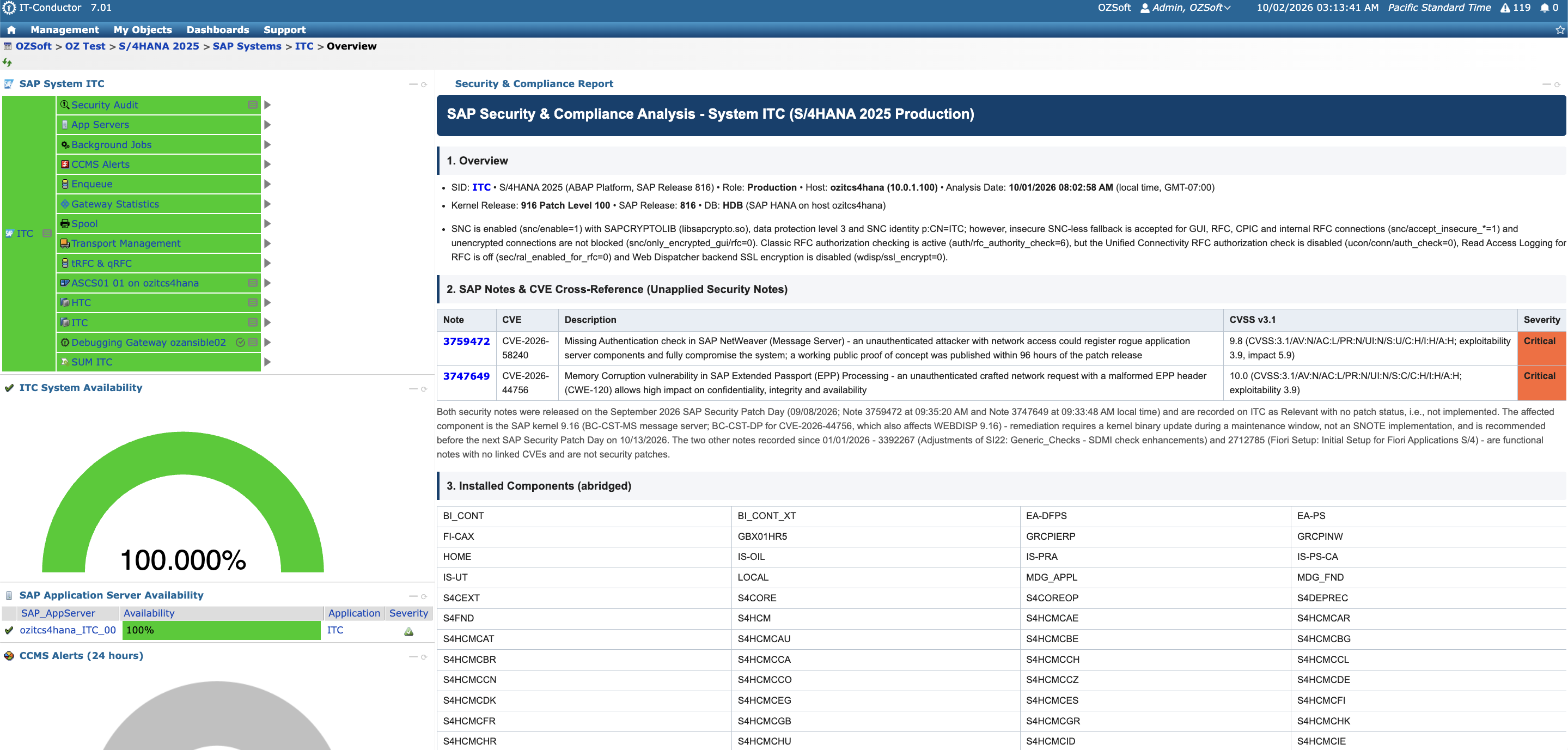 Figure 1: SAP Security and Compliance Analysis Overview
Continuous analysis starts before SAP Security Patch Day
SAP kernel vulnerabilities are a good example.
A vulnerability may first become publicly known through vulnerability databases such as CVE and NIST. IT-Conductor SecureOps can analyze available vulnerability information ahead of the formal SAP Security Note cycle and determine whether the affected software exists in the managed SAP environment.
When SAP subsequently publishes the relevant Security Note, IT-Conductor SecureOps can connect that information back to the actual system.
The result is a continuous process:
- Vulnerability information becomes available
- Affected software is identified
- System applicability is evaluated
- Risk is scored
- Remediation is initiated when appropriate
Security does not have to wait for the monthly calendar.
SAP Notes are automatically analyzed
IT-Conductor SecureOps also continuously manages SAP Security Notes for connected systems.
Once an SAP system is managed by IT-Conductor, IT-Conductor SecureOps can connect to SAP support and automatically download relevant security notes to the system. The notes can then be evaluated for applicability and implementation status.
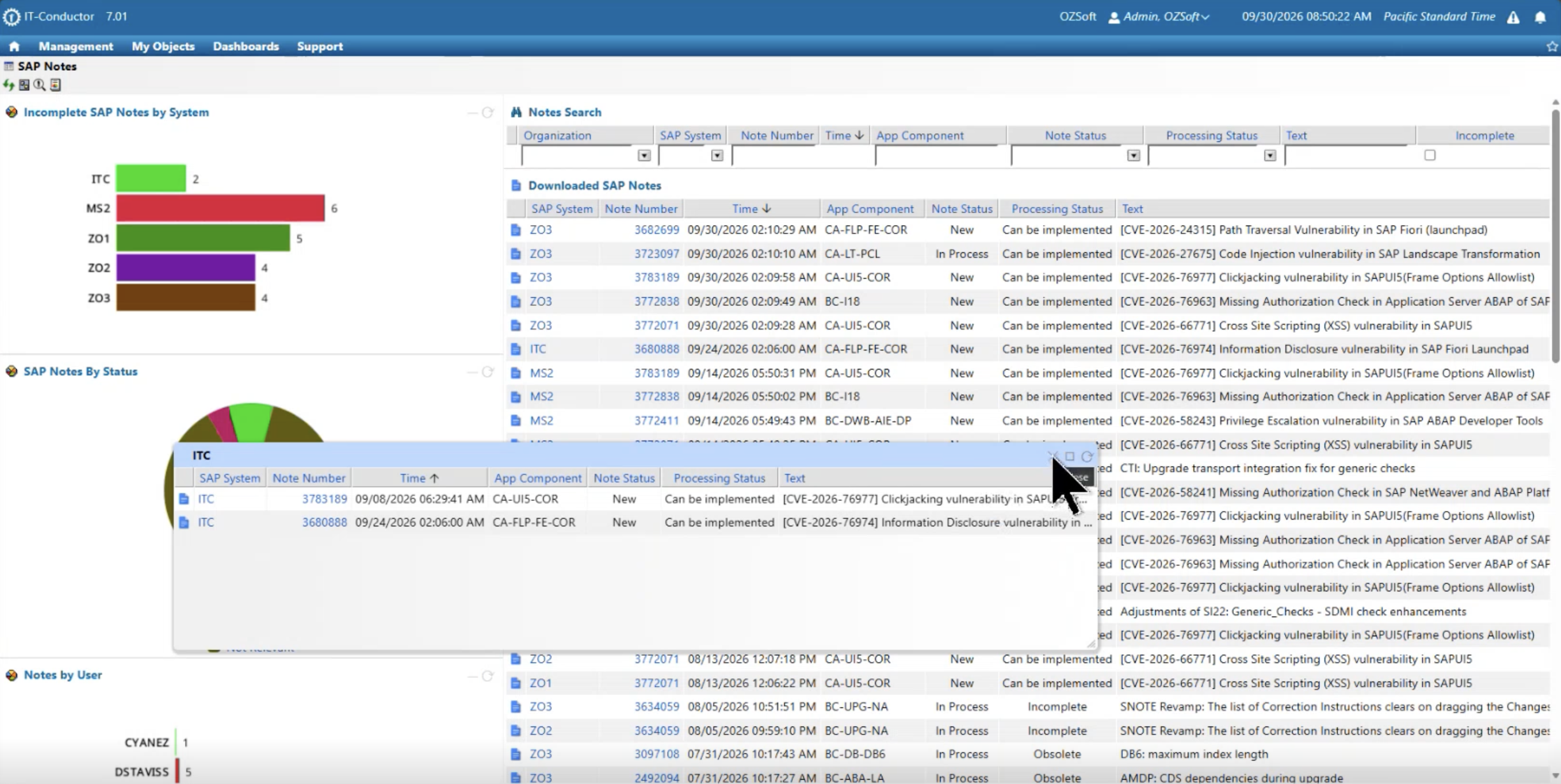 Figure 2: Processed SAP Notes
This changes the traditional process.
Instead of manually downloading a monthly list of notes, reviewing every note, and creating separate remediation work, the platform can continuously maintain the system-specific view of relevant notes.
For applicable notes, the process can continue into remediation.
IT-Conductor's integrated change-management capabilities can create and manage the transport workflow, including approvals and import tracking.
This creates a direct connection between:
SAP Security Note → Applicability → Remediation Task → Transport → Implementation
September 2026: A real-world patching exercise
The September 2026 SAP Security Patch Day provided a practical example of this continuous process.
SAP's September Security Patch Day on September 8 included 19 new security notes and one update to a previously released note. Among the critical vulnerabilities was SAP Note 3747649, associated with CVE-2026-44756 and a CVSS score of 10.0, affecting multiple SAP kernel and Web Dispatcher releases.
For the assessed SAP S/4HANA production system, the security analysis identified applicable vulnerabilities and evaluated them alongside the rest of the system's security posture.
The important point was not simply identifying the new SAP Notes.
IT-Conductor SecureOps also asked, "What else is happening in this system?"
Looking beyond the patch list
A secure SAP environment cannot be assessed by patch status alone.
The IT-Conductor SecureOps analysis evaluated multiple security dimensions, including:
- Platform
- Configuration
- Application
- Identity & Access
- Security audit activity
- System-specific SAP Notes
- Existing incidents and remediation status
The assessment identified configuration weaknesses such as insecure SNC fallbacks, unencrypted communication paths, disabled RFC authorization checks, Web Dispatcher encryption settings, password-policy weaknesses, and other hardening gaps.
It also analyzed security audit activity rather than treating patching as an isolated exercise.
This matters because a system can be fully patched and still have significant security exposure.
Risk is scored, not just listed
IT-Conductor IT-Conductor SecureOps goes beyond producing a list of vulnerabilities.
The findings are scored and prioritized according to their potential risk and the effort required to remediate them.
This gives the operations team a much more useful question than “How many vulnerabilities do we have?”
Instead, “Which risks matter most, what should we remediate first, and what will it take to fix them?”
The SRI assessment brings these findings together into a measurable view of the system's resilience.
Measuring the system before and after patching
The September exercise also provided an opportunity to measure the effect of remediation.
An SRI assessment conducted on September 4, 2026, established the baseline before patching.
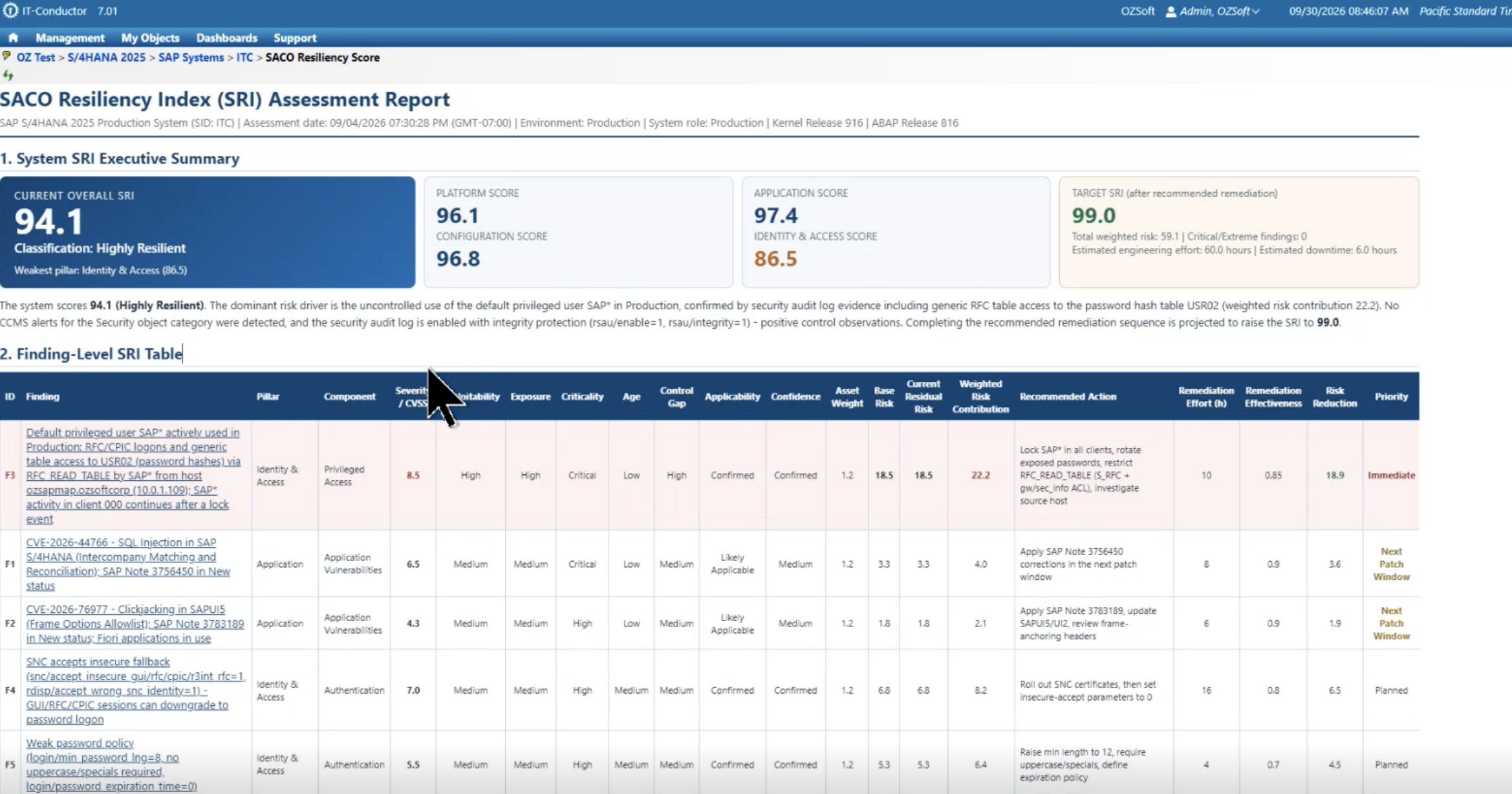
Figure 3: SACO Resiliency Index (SRI) Assessment Report
Before patching
Overall SRI: 94.1 (Highly Resilient)
The assessment identified the system's highest-risk areas and provided a prioritized remediation sequence.
Following the patching activity, the system was reassessed on October 1, 2026.
After patching
Overall SRI: 94.7 (Resilient)
The comparison showed improvement across several areas:
|
SRI Measure |
Before | After |
|
Overall SRI |
94.1 |
94.7 |
|
Platform |
96.1 |
96.2 |
|
Configuration |
96.8 |
98.4 |
|
Identity & Access |
86.5 |
89.3 |
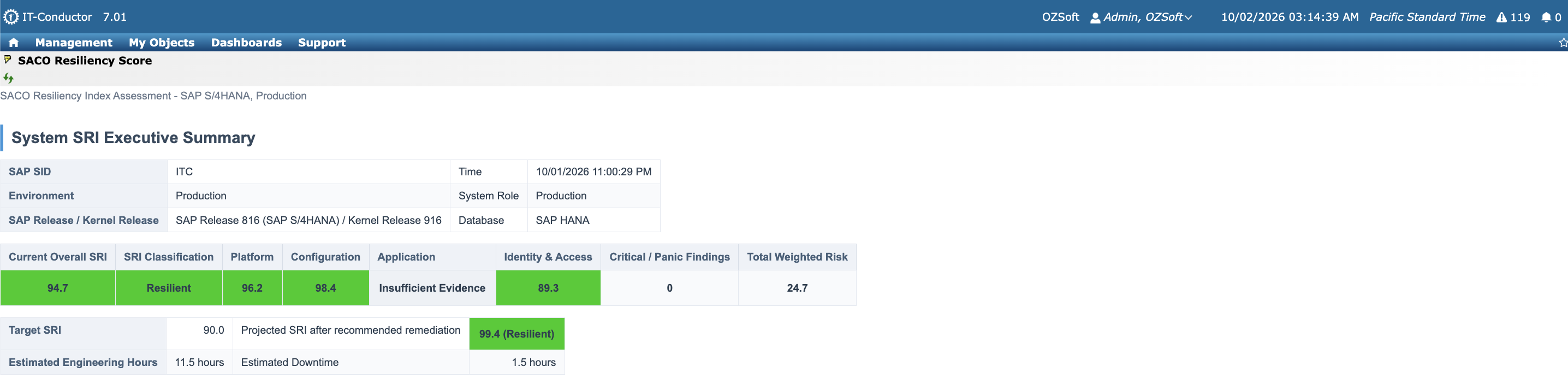 Figure 4: SACO Resiliency Score (System SRI Executive Summary)
The post-patching assessment also showed that the previously identified critical kernel vulnerabilities were no longer appearing as outstanding security-note findings.
This is an important distinction:
The SRI score is not simply a compliance checkbox. It provides a measurable way to compare the system's security posture over time.
From vulnerability to automated remediation
Finding a vulnerability is only useful if it leads to action.
IT-Conductor SecureOps connects findings to remediation workflows, including automation.
For SAP Notes, remediation can be handled through IT-Conductor's automation library, including automated notes deployment in non-Production system for supported components, as well as change-management and transport capabilities. In the demonstrated environment, a remediation transport was created, approved, imported, and tracked through the workflow.
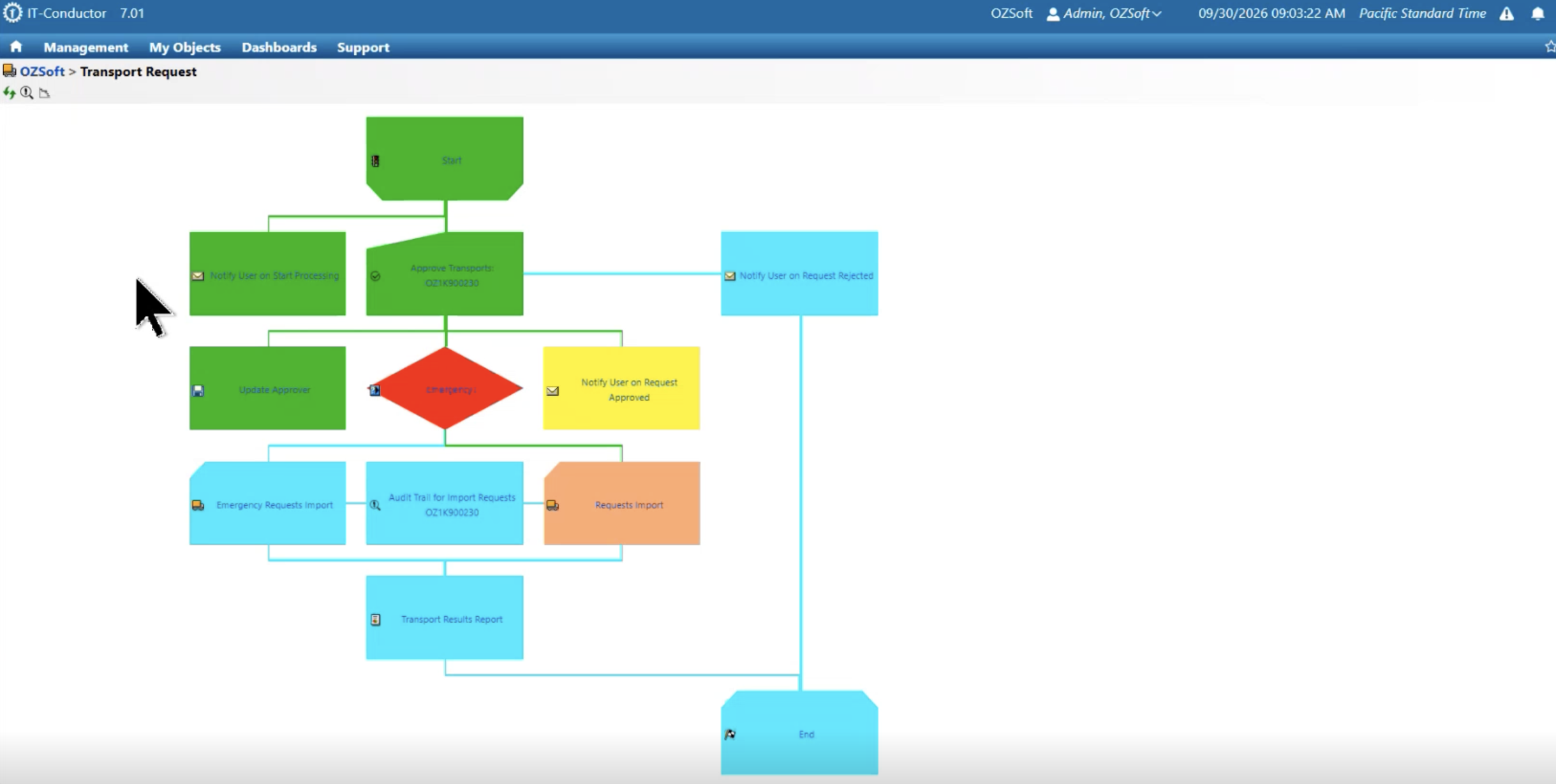 Figure 5: Remediation workflow for SAP Security Notes
For kernel vulnerabilities, IT-Conductor can go further.
Kernel patching can be executed through automation that:
- selects the required kernel release and patch level
- retrieves the required patch bundle
- preserves the existing kernel
- stops and starts the required SAP components
- performs the kernel update
- supports rollback to a previous kernel version
- tracks the execution through the workflow
The automation library can also integrate with IT-Conductor's central SAP download management so that kernel bundles can be prepared and made available for automated deployment.
This turns kernel patching from a complex sequence of manual activities into a controlled, repeatable workflow.
Configuration remediation is part of the same cycle
The same principle applies beyond SAP Notes.
Configuration findings can also become remediation tasks.
For example, if IT-Conductor SecureOps identifies an insecure SNC configuration or a weak password policy, the finding can be scored, prioritized, assigned, and remediated as part of the same operational process.
This is important because SAP security responsibilities are often distributed across different teams.
One team may handle SAP application notes.
Another may manage the kernel.
Another may manage infrastructure.
Another may own identity and access.
Another may be responsible for security monitoring.
IT-Conductor SecureOps brings those findings together around the system's overall security posture rather than treating each team and tool as a separate silo.
Security monitoring continues after the patch
Patching also does not erase the need to investigate what happened before remediation.
If a vulnerability existed for a period of time, security teams need to understand whether it was exploited and whether suspicious activity occurred.
IT-Conductor SecureOps continuously analyzes security audit information and can correlate findings with incidents, remediation records, and postmortem information.
This creates an important security principle: Fixing a vulnerability is not the same as proving that the vulnerability was never exploited.
The system therefore continues analyzing audit activity after remediation.
This provides a feedback loop between vulnerability management, security monitoring, incident management, and remediation.
The remediation loop
The resulting operating model is fundamentally different from a monthly patching checklist.
1. Detect
Identify new vulnerabilities, SAP Security Notes, configuration risks, and suspicious activity.
2. Analyze
Determine whether the finding actually applies to a specific SAP system.
3. Score
Measure the risk and understand its contribution to the overall system resilience.
4. Prioritize
Determine what needs attention first based on risk, remediation effort, and business impact.
5. Remediate
Create the required task and execute the appropriate remediation — manually or through automation.
6. Validate
Reassess the system and verify that the finding has been resolved.
7. Continue
Keep monitoring for new vulnerabilities and new security risks.
The loop does not stop when SAP publishes the next month's Security Notes.
Why automation matters in SAP Security
Continuous security analysis only creates value if organizations can keep up with the remediation workload.
This is where automation becomes particularly important.
The September exercise demonstrated automated remediation for SAP application vulnerabilities and kernel patching, while the platform can also orchestrate system shutdown and startup, transport workflows, and other operational activities.
Automation reduces the amount of manual coordination required between teams and makes remediation more repeatable.
It also changes the economics of security operations.
A remediation that requires several engineers to coordinate manually can become a standardized workflow that can be executed consistently.
The more remediation activities that can be automated, the more practical it becomes to maintain continuous compliance rather than waiting for a monthly maintenance cycle.
From patch management to cyber resilience
The September exercise demonstrates a broader change in how SAP security can be operated.
Traditional patch management asks, “What did SAP publish this month?”
A continuous cyber-resilience approach asks, “What is changing in my environment, what risks affect my systems, what should I do about them, and can I prove that the risk has been reduced?”
That requires more than Security Notes. It requires:
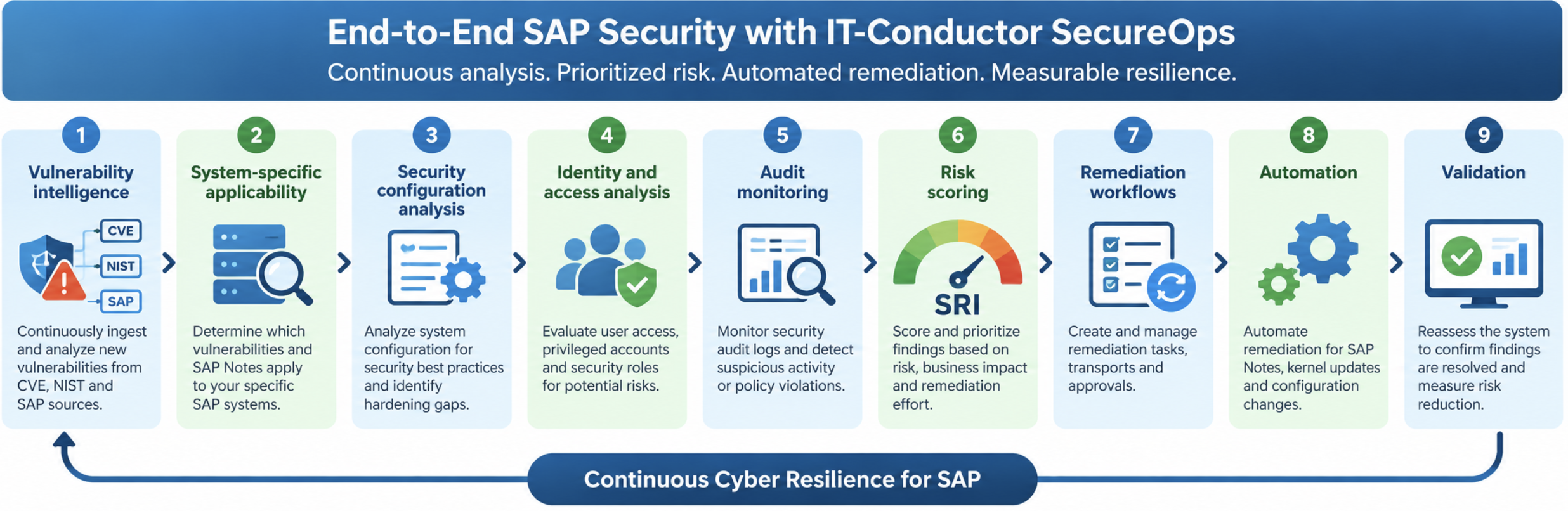
IT-Conductor SecureOps brings these capabilities together into a continuous operational loop.
September patching exercise in one view
The September patching exercise demonstrated a continuous security workflow rather than a process limited to SAP’s monthly Patch Day. IT-Conductor SecureOps continuously analyzes the SAP environment, automatically downloads and assesses newly available SAP Security Notes, identifies system-specific findings, and evaluates their risk through the SACO Resiliency Index (SRI).
From there, applicable remediation tasks can be created and executed through controlled workflows and automation, including the application of SAP Notes and kernel updates. Once remediation is performed, the system is reassessed to validate the changes and measure the resulting risk reduction.
For the September exercise, the September 4 assessment established a baseline SRI of 94.1. Following the patching and remediation activity, the October 1 reassessment showed an SRI of 94.7, while also identifying the remaining security and configuration risks.
The process then continues into the next remediation cycle. Remaining findings can be prioritized and modeled through the SRI to understand their potential risk reduction, engineering effort, and downtime before remediation is undertaken.
In other words, IT-Conductor SecureOps turns SAP vulnerability management into a continuous cycle of detection, assessment, remediation, validation, and risk measurement — not a once-a-month activity tied only to Patch Tuesday.
Moving from monthly patching to continuous SAP security compliance
SAP’s monthly Security Patch Day provides an important release of new security information. But it is only one point in an ongoing security lifecycle.
IT-Conductor SecureOps continuously evaluates the SAP environment for new vulnerabilities, system-specific applicability, configuration weaknesses, security events, and other changes that could affect the system’s security posture. Relevant findings can be scored, prioritized, and connected directly to remediation workflows.
The September exercise illustrates this continuous approach. The system was assessed before patching, remediation activities were performed through controlled workflows and automation, and the environment was reassessed afterward to measure the change in its security posture. The SRI increased from 94.1 before patching to 94.7 after the exercise, while the reassessment also identified remaining risks for the next remediation cycle.
The result is a shift from monthly patch management to continuous cyber resilience: continuously identifying what has changed, understanding what matters, taking action, and measuring whether risk has been reduced.
The real measure: How quickly can risk be reduced?
A recent incident involving the FBI highlights why patching cannot be measured simply by whether a security update was eventually applied.
According to a recent report from The Cyber Security Hub, the FBI removed a contractor after determining that a failure to install a security patch contributed to a breach involving sensitive employee information. The report also highlights an important governance question: how do organisations verify that critical security work has actually been completed across the systems they are responsible for?
The lesson is broader than one incident or one technology stack. Once a vulnerability is known and a remediation is available, time becomes a security control.
This is where Mean Time to Remediate (MTTR) becomes an important operational metric.
A mature security operation should be able to answer:
- How quickly was the vulnerability identified?
- How quickly was its applicability to the environment determined?
- How quickly was remediation initiated?
- How quickly was the fix deployed?
- And, critically, how quickly was remediation verified?
Closing a ticket or receiving confirmation from a service provider is not the same as proving that the affected production systems are protected. The report makes this distinction explicitly, noting that effective patch management includes verifying installation, not simply identifying, prioritising and installing updates.
This is why continuous security operations matter. The objective is not simply to react to SAP Patch Day. It is to minimize the time between discovering a material risk and proving that the risk has been reduced.