SAP
Benchmarking SAP Transformation Strategy
Benchmark your SAP transformation strategy and learn how peer insights help reduce risks, improve decision-making, and drive better outcomes.
How autonomous cyber resilience is transforming SAP security operations. From vulnerability detection to orchestrated remediation.
SAP systems are no longer isolated back-office platforms. They now sit at the center of manufacturing, finance, logistics, procurement, and supply chain operations, making them some of the most critical and high-value systems in the enterprise.
As organizations accelerate S/4HANA migrations, adopt SAP BTP, and expand hybrid cloud architectures, operational complexity continues to grow. At the same time, cyber threats targeting ERP environments are increasing in both sophistication and frequency.
The challenge is no longer just detecting vulnerabilities. The real challenge is operational response.
Security teams today must manage growing volumes of CVEs, SAP Security Notes, identity risks, configuration drift, suspicious activity, compliance requirements, and infrastructure exposure across increasingly distributed environments. Many organizations still rely on fragmented monitoring tools, spreadsheets, manual workflows, and disconnected remediation processes that struggle to keep pace with modern SAP operations.
This is where autonomous cyber resilience becomes essential.
At IT-Conductor, we see autonomous cyber resilience for SAP operations as the convergence of observability, operational orchestration, automation, and AI-assisted decision support — helping enterprises improve detection, accelerate remediation, and strengthen operational resilience across SAP landscapes.
This vision is gaining broader momentum across the SAP ecosystem. At SAP Sapphire 2026, SAP unveiled Autonomous Enterprises, a strategic direction centered on uniting AI agents with core business processes so that humans and AI work together to handle the accelerating demands of global business. The direction is clear: the future of enterprise SAP operations is autonomous, orchestrated, and AI-assisted. Cybersecurity and resilience must evolve at the same pace.
Modern SAP environments span far beyond traditional ERP systems.
Today’s landscapes often include:
S/4HANA
SAP BTP services
HANA databases
Linux infrastructure
Hybrid cloud environments
Identity services such as IAS and IPS
APIs and integration platforms
Third-party SaaS applications
Each layer introduces additional operational and security complexity.
At the same time, organizations face ongoing shortages of experienced SAP Basis and cybersecurity professionals. Security operations centers (SOCs) often lack deep SAP operational context, making it difficult to properly interpret SAP-specific telemetry, prioritize threats, or coordinate remediation activities efficiently.
Traditional SIEM platforms can ingest logs and alerts, but they frequently require significant customization to properly understand SAP operational behaviors such as:
RFC misuse
Suspicious transport activity
Privileged transaction abuse
HANA-level anomalies
SAP kernel vulnerabilities
Batch-job persistence techniques
BTP entitlement drift
SAProuter exposure
Identity federation risks
Without a SAP-aware operational context, critical threats may remain unresolved for too long.
One of the foundational capabilities of cyber resilience is continuous visibility into vulnerabilities affecting enterprise environments.
IT-Conductor provides visibility, reporting, operational correlation, and remediation workflow support for Common Vulnerabilities and Exposures (CVEs) affecting Linux systems, SAP applications, databases, and supporting infrastructure components.
This helps operations and security teams:
Identify vulnerabilities affecting their environment
Understand impacted systems and components
Prioritize remediation activities
Support monthly patching cycles
Reduce exposure windows
Improve operational awareness
Vulnerabilities can be categorized across areas such as:
Network exposure
Local vulnerabilities
Privilege escalation
Remote execution risks
Configuration weaknesses
Physical access risks
Centralized dashboards and reporting provide security teams with a clearer operational view of vulnerabilities across the SAP landscape, helping organizations maintain stronger visibility and governance.
As response windows for critical vulnerabilities continue shrinking, organizations need operational processes capable of responding faster and more consistently.
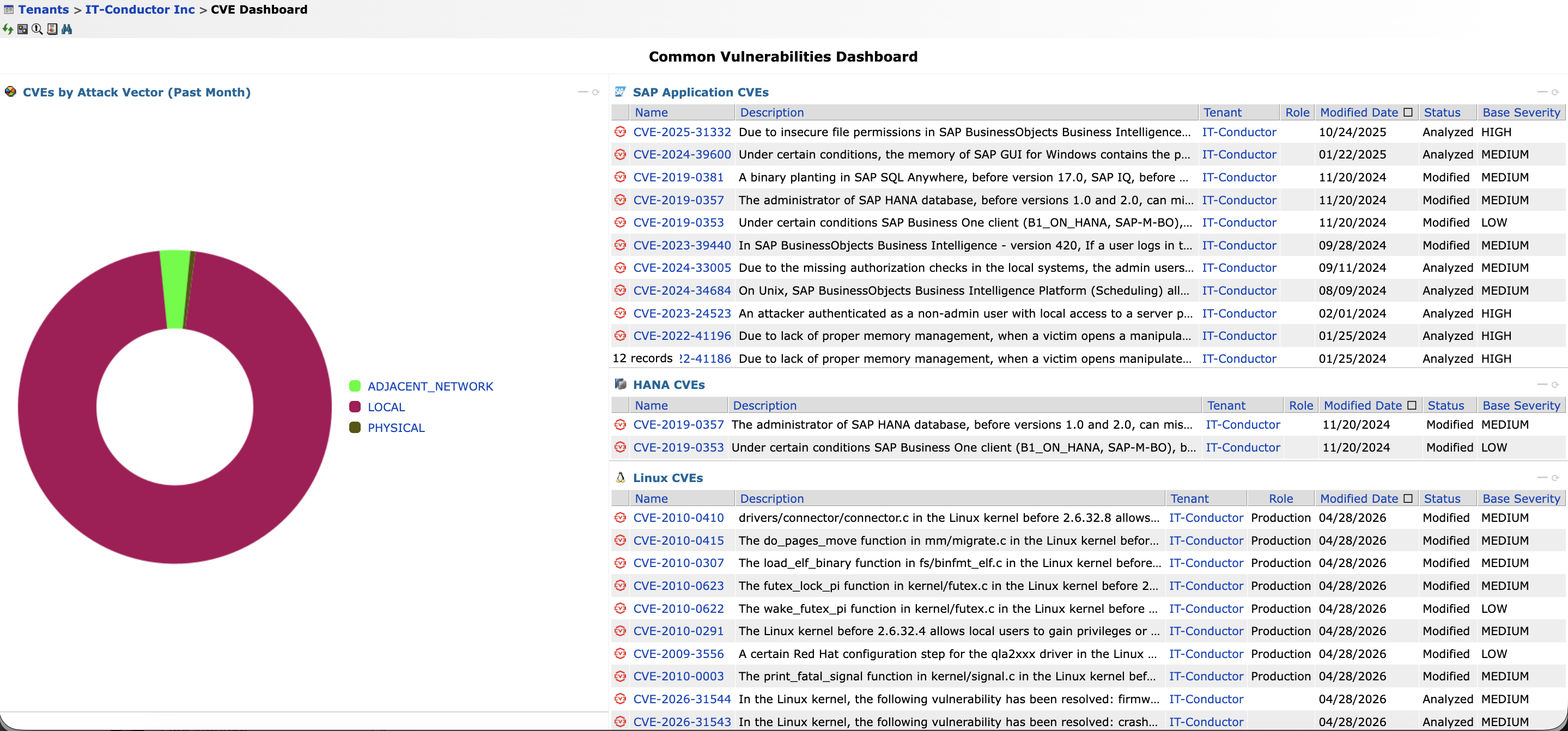 Figure 1: CVE Dashboard
Detecting vulnerabilities is only part of the problem.
The real operational challenge begins after identification:
Determining affected systems
Validating dependencies
Coordinating Basis and infrastructure teams
Scheduling downtime
Managing transports
Executing remediation safely
Validating post-change integrity
Documenting compliance activities
In many organizations, these workflows remain fragmented across emails, spreadsheets, ticketing systems, and manually executed runbooks.
This creates operational delays, inconsistent processes, and increased security risk.
Autonomous cyber resilience introduces orchestration into the remediation lifecycle, helping organizations standardize and accelerate operational response workflows while maintaining governance and human oversight.
Instead of isolated alerts, operations teams gain structured remediation processes connected to operational workflows and recovery procedures.
Modern cyber resilience requires more than passive monitoring.
IT-Conductor helps bridge the gap between detection and operational response by connecting monitoring insights with orchestrated remediation workflows.
Examples include:
Locking suspicious SAP or HANA accounts
Triggering recovery workflows
Launching remediation runbooks
Coordinating kernel patch activities
Supporting SAP Security Note deployment workflows
Guiding restart and recovery procedures
Automating ticket creation and escalation
Supporting operational response coordination across teams
The focus is not fully autonomous production changes without oversight. Instead, the goal is guided and orchestrated remediation that helps operations teams respond faster, more consistently, and with greater operational awareness.
Future roadmap capabilities may leverage agentic AI models to assist with:
anomaly analysis
telemetry correlation
remediation recommendations
operational decision support
workflow coordination
prioritization of operational response actions
This creates the foundation for more adaptive and resilient SAP operations over time.
Enterprise operations are moving toward more intelligent and orchestrated operational models.
Organizations increasingly want platforms capable of combining:
Operational observability
Security awareness
Workflow orchestration
Automation
Compliance support
Incident response coordination
This convergence is creating a major opportunity for autonomous SAP security operations.
The need is especially urgent because SAP systems now sit at the intersection of:
Business continuity
Cybersecurity
Compliance
Cloud transformation
Operational resilience
As cyber threats continue evolving and SAP environments become more distributed, enterprises can no longer rely entirely on manual coordination and disconnected tooling to maintain resilience.
They need operational systems capable of improving visibility, accelerating remediation, and supporting coordinated response processes across complex SAP landscapes.
Cyber resilience is evolving from reactive monitoring into operational coordination and intelligent response.
The next generation of SAP operations will increasingly depend on:
Orchestrated remediation
Operational automation
AI-assisted analysis
Continuous compliance validation
Adaptive operational workflows
Integrated security and operations visibility
Organizations that modernize their operational response capabilities now will be better positioned to reduce operational risk, improve resilience, and respond more effectively to future cyber threats.
Autonomous cyber resilience is not simply another security tool.
It is an operational approach designed to help enterprises manage the growing complexity of modern SAP environments while strengthening both operational stability and security posture.
We're bringing this topic to life in our upcoming webinar. Join the IT-Conductor team as we explore what autonomous SAP security operations look like in practice. From continuous vulnerability monitoring and orchestrated remediation to AI-assisted decision support across complex SAP landscapes. We'll also be discussing Maestro, IT-Conductor's AI orchestration agent, the intelligence that coordinates every operation into a unified, autonomous workflow.
Register now to secure your spot.
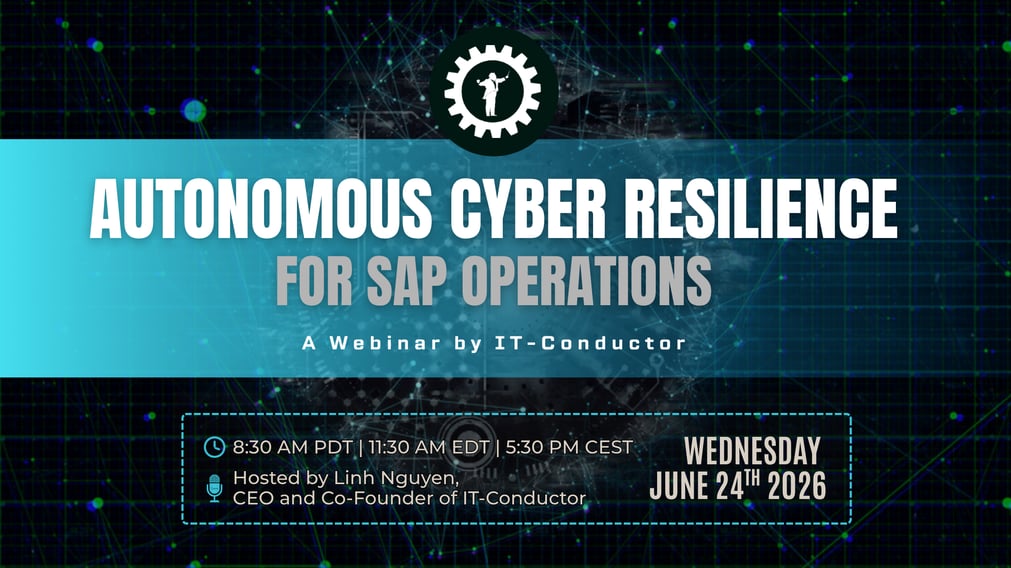 Figure 2: Autonomous Cyber Resilience for SAP Operations Webinar
Benchmark your SAP transformation strategy and learn how peer insights help reduce risks, improve decision-making, and drive better outcomes.
Struggling with SAP security backlogs? See how AI-assisted remediation helps teams close vulnerabilities faster with SecureOps.
IT-Conductor SecureOps is now on SAP Store and AWS Marketplace, enabling AI-assisted, governed SAP cybersecurity and remediation.