SAP Cybersecurity
Webinar Recap: Anatomy of an SAP Cyber Attack
On July 29th, we hosted a webinar exploring how attackers move through SAP systems and how autonomous cyber operations improve detection.
On September 2nd, we hosted a webinar exploring how SAP-aware analysis and governed automation can extend cyber response beyond business hours.
A critical SAP security signal arrives at 2:17 AM. The security operations center (SOC) can see the alert, but the SAP expert who understands the affected systems, technical dependencies, and change risks is offline. Should the team patch immediately, implement a temporary configuration change to reduce exposure, escalate the issue, or wait?
In the eighth session of the Rise of SAP Autonomous Cyber Operations webinar series, IT-Conductor CEO Linh Nguyen explored how organizations can respond to SAP cyber risks around the clock without requiring SAP specialists to be available at all times.
SAP systems support critical business processes continuously, and cyber threats can occur at any time. Yet even organizations with follow-the-sun operating model may not have the same level of SAP security knowledge available at all times.
The session highlighted the growing tension between an always-on security requirement and a limited pool of specialists. SAP Basis and platform teams understand the landscape, but they also manage upgrades, patching, transports, users, and daily operations. SOC teams may monitor alerts continuously, but they do not always have enough SAP context to determine whether a finding is technically applicable or operationally urgent. CISOs and risk leaders, meanwhile, need assurance that decisions are governed, traceable, and supported by current evidence.
When ownership is unclear, a signal can remain unresolved while teams search for the right person. Even when the relevant expert is eventually reached, that person still needs to determine which systems are affected, weigh exploitability against business impact, review change constraints, and decide whether to patch, compensate, escalate, or defer. The skills gap becomes a resilience gap whenever the response process depends on a particular expert being available.
In the webinar, Linh mapped the SAP cyber response chain across five stages: signal, context, decision, action, and proof.
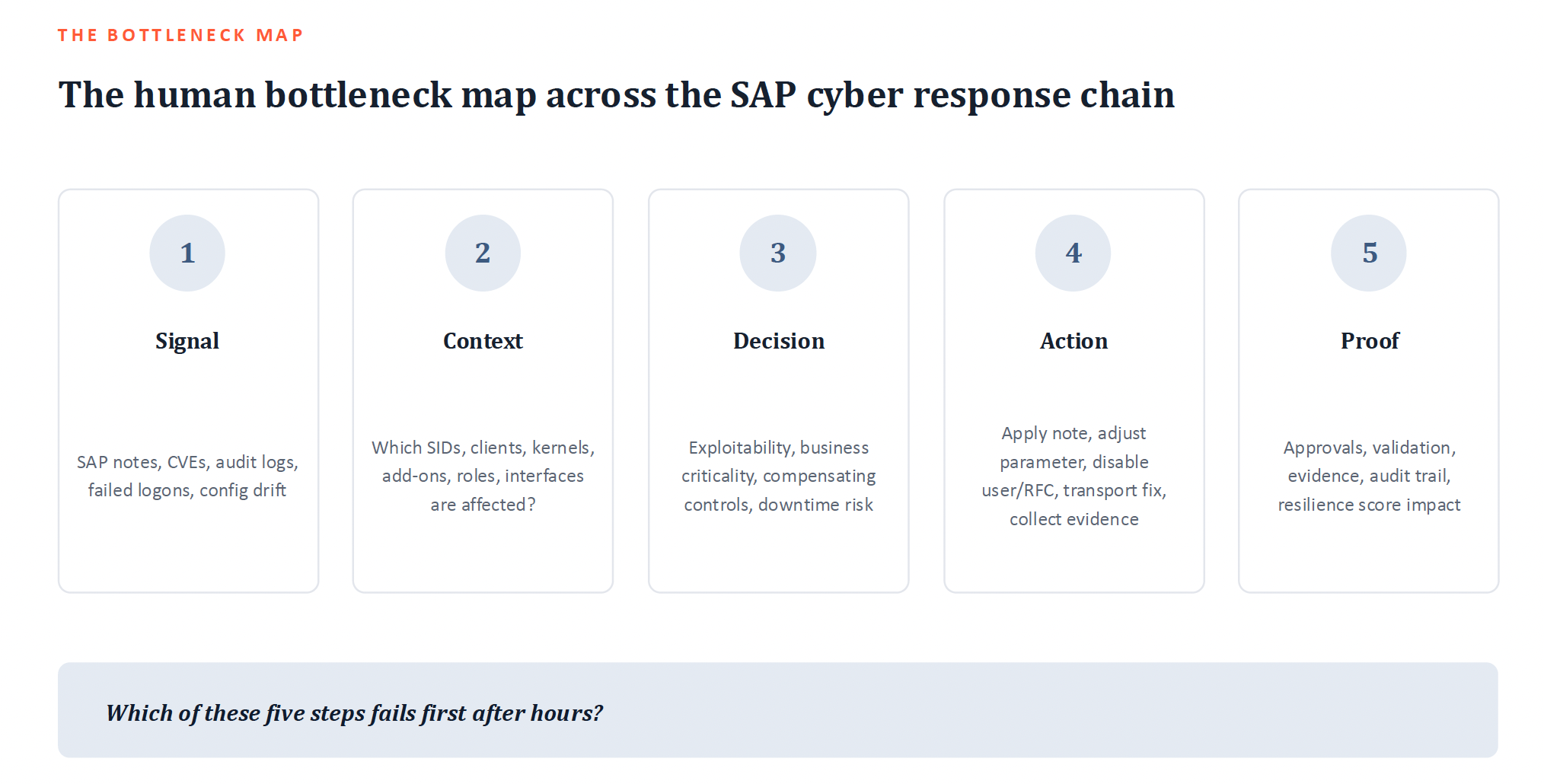 Figure 1: SAP Cyber Response Chain
Existing tools may detect a new SAP Security Note, CVE, failed-logon pattern, configuration change, or suspicious activity. However, detection alone does not establish what the signal means for a specific SAP environment. Teams still need to connect it to the relevant SIDs, clients, kernel and add-on levels, roles, interfaces, transport paths, business processes, and change windows.
From there, they need to assess exploitability, business criticality, existing controls, potential downtime, and the safest course of action. Only after that analysis can they apply a note, adjust a parameter, deactivate a user, introduce a compensating control, or route the finding for further review.
The process does not end with remediation. Organizations must also retain approvals, validation results, logs, tickets, and other evidence showing that the right action occurred under the right control. As Linh emphasized in the webinar, the bottleneck is often not a lack of tools, but a breakdown in the response chain, particularly when the team cannot make or authorize the next decision.
A generic alert may include a severity score, network exposure, failed logons, an endpoint signal, or a cloud finding. For the SOC to act safely, that information must be mapped to the reality of the SAP landscape.
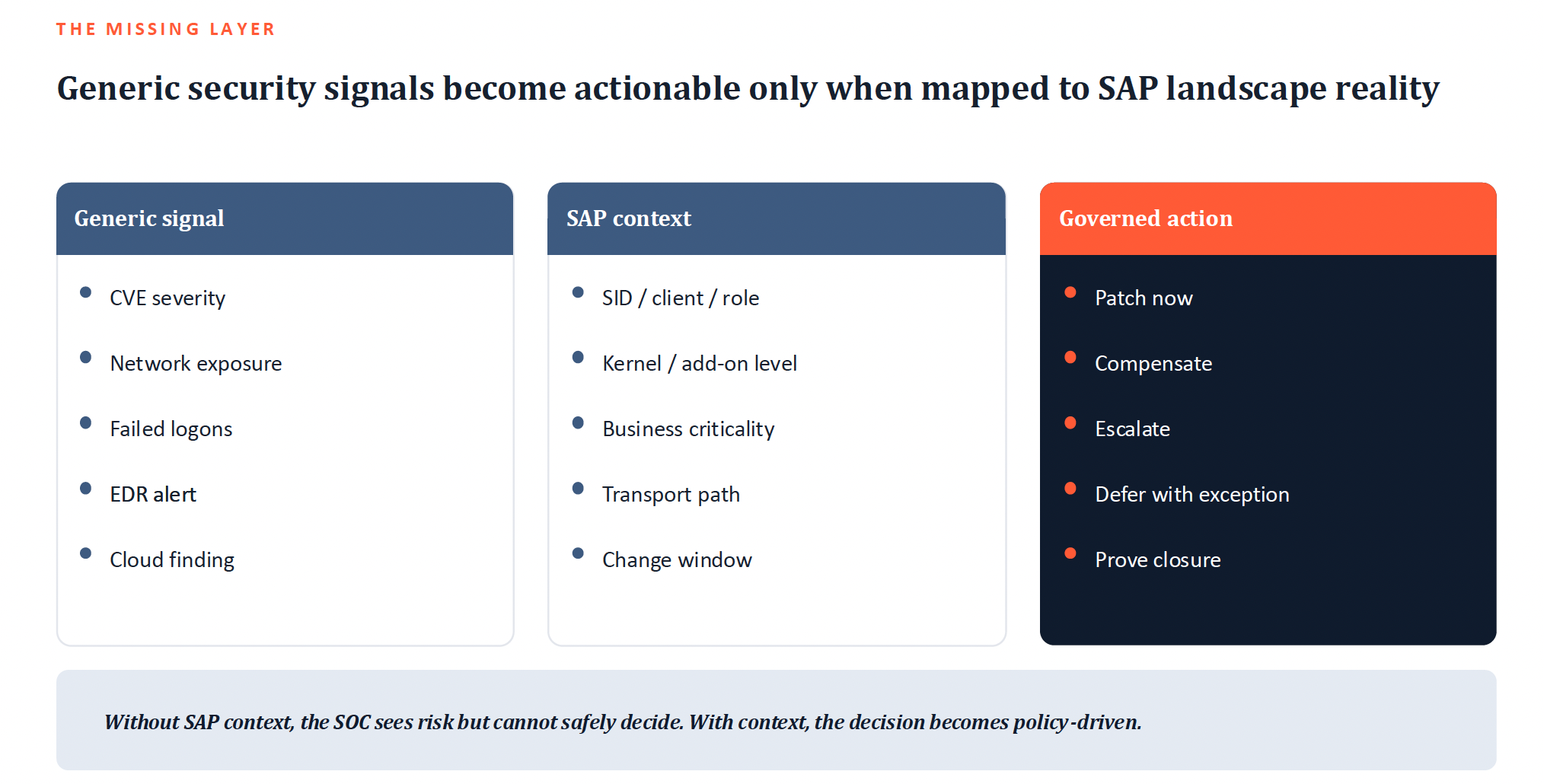 Figure 2: The Missing Layer
IT-Conductor SecureOps brings the signal together with system-specific context such as the affected SID and client, installed component and kernel levels, exposed services, user or role, business criticality, transport path, patch baseline, and approved change window. Rather than relying on severity alone, teams can assess whether the issue applies to their environment, how much risk it presents, and which systems or business processes could be affected.
With this context, the SOC can take an appropriate next step without making assumptions about the SAP environment. Some findings may require immediate escalation, while others can follow an approved workflow, wait for a scheduled maintenance window, or be dismissed after the system confirms that they are not applicable. The response remains guided by policies and decision boundaries established by SAP and security experts.
Moving toward autonomous security operations does not require organizations to hand over every decision at once. In the webinar, Linh presented a five-stage adoption path that gradually increases autonomy while preserving governance.
 Figure 3: Adoption Path to Controlled Autonomy
The five stages provide a gradual path toward controlled autonomy:
Throughout these stages, approval requirements, change windows, segregation of duties, rollback plans, exception handling, and validation remain part of the workflow. Actions already determined to be safe can proceed under policy, while higher-risk or ambiguous situations continue to require expert review.
The webinar highlighted three scenarios where SAP-aware context and predefined playbooks can help teams respond more consistently:
These scenarios show how expert-governed response enables teams to act on urgent risks, initiate predefined workflows for approved actions, and escalate decisions that require deeper SAP expertise.
Organizations can measure the shift by tracking how quickly teams detect risks, assess applicability, decide on a response, and remediate or reduce exposure. Evidence completeness also shows whether faster response maintains traceability and audit readiness.
Progress can also be measured through the SACO Resiliency Index (SRI), which provides a consistent way to assess SAP cyber resilience and track how the organization’s posture changes as findings are addressed.
Continuous scoring adds another dimension. When a finding is resolved and validation confirms the result, teams can see how the action changes residual exposure and the broader SRI score across platform, configuration, application, and identity and access management. Actual effort and downtime can also improve future estimates, helping leaders understand the capacity, maintenance windows, and resources required for the next phase of remediation.
Together, these measures translate the operating model into an executive outcome: less time with critical exposure unresolved, clearer priorities for limited engineering capacity, and stronger proof that controls are working.
The demonstration of the incident brought the after-hours scenario to life by showing how IT-Conductor SecureOps can help teams respond when an SAP security expert is unavailable.
Watch the demonstration to see how SAP-aware context, risk-based prioritization, and predefined playbooks work together to support a faster and more controlled response.
The webinar concluded with a practical four-week approach.
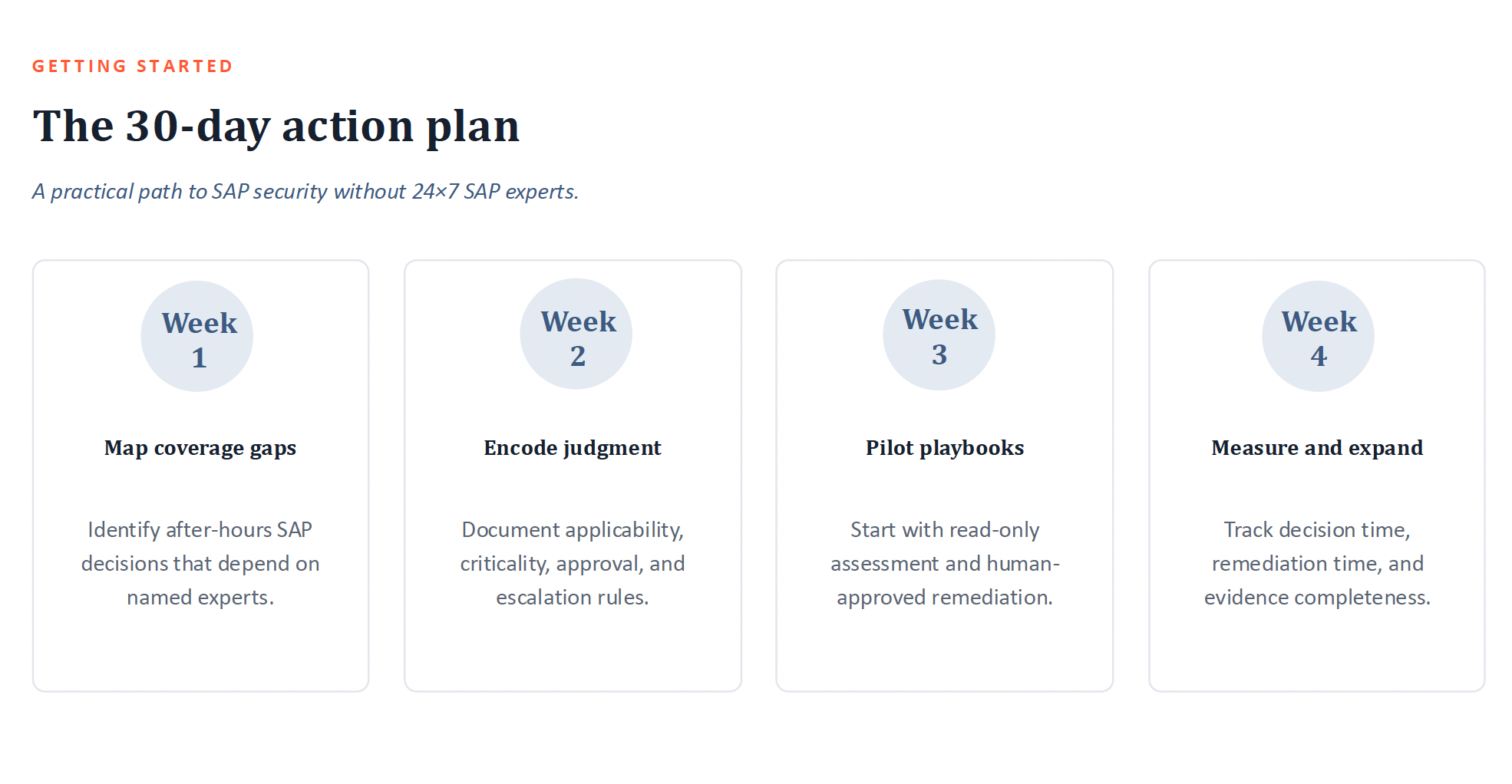 Figure 4: 30-Day Action Plan to SAP Security Without 24x7 SAP Experts
During the first week, organizations can map after-hours coverage gaps and identify decisions that currently depend on named experts. In week two, they can document applicability criteria, system criticality, approval requirements, exception rules, and escalation boundaries.
Week three focuses on piloting a small number of playbooks, beginning with read-only assessment and human-approved remediation. Teams can test those playbooks through tabletop exercises and confirm that ownership, pre-checks, validation, notifications, rollback, and evidence capture work as expected. In week four, they can measure decision time, remediation time, and evidence completeness, then refine the rules and expand to additional scenarios.
Starting with one recurring, high-value decision is more practical than attempting to automate every security activity at once. A well-governed playbook for a suspicious privileged user, an urgent applicable note, or a critical configuration drift can show how existing expertise becomes reusable operational capacity.
The most important takeaway from the webinar is that 24×7 SAP security does not require every SAP expert to remain online around the clock. Instead, organizations can capture their judgment in explicit policies, approved playbooks, and clear decision and escalation boundaries.
Specialists retain authority over high-impact decisions, while SOC teams and other authorized operators can respond to predefined scenarios when an SAP expert is unavailable. IT-Conductor SecureOps supports this model by carrying findings from detection and prioritization through governed remediation, validation, and evidence capture, reducing reliance on spreadsheets and ad hoc after-hours escalation.
SAP cyber risks can emerge at any time, so response processes must support continuous action. Achieving that coverage depends on SAP-aware automation that operates within expert-defined boundaries and maintains a verifiable record of every action.

On July 29th, we hosted a webinar exploring how attackers move through SAP systems and how autonomous cyber operations improve detection.
On September 16th, we hosted a webinar exploring how organizations can build an autonomous SAP Security Operations Center with AI and orchestration.
On August 5th, we hosted a webinar exploring how SAP security must be built across platform, configuration, application, and identity domains.