On September 23rd, we hosted a webinar on quantifying cyber risk and building the business case for autonomous SAP cyber operations.
The economics of SAP cyber operations goes far beyond software and licensing costs. Organizations also need to account for downtime, recovery, delayed remediation, manual security work, and the specialist capacity consumed by tasks that could otherwise be automated. When these costs remain scattered across teams and budgets, it becomes extremely difficult to show what is truly costing the business or where automation can deliver measurable value.
In the eleventh session of the Rise of SAP Autonomous Cyber Operations webinar series, IT-Conductor CEO Linh Nguyen examined how organizations can make those costs more visible and build a stronger economic case for autonomous SAP cyber operations. The discussion focused on the cost of inaction, the ongoing expense of manual operations, the limitations of detection-only tools, and how governed automation can reduce friction, reclaim specialist time, and lower the cost of moving findings to closure.
Why do the economics of SAP cybersecurity matter now?
SAP cybersecurity is competing with AI, cloud initiatives, transformation projects, and day-to-day operations for the same limited budget, specialist talent, and operational capacity. At the same time, teams are being asked to protect more systems, respond faster, and produce more evidence. When budget, talent, and capacity are finite, security investments need to be evaluated by the outcomes they produce, not simply by the risks they are intended to address.
Leaders need to understand what security investments actually reduce in terms of exposure, manual effort, remediation time, and operational disruption. The challenge is that these considerations are often distributed across the organization. CISOs see risk, Finance sees spend, and SAP platform owners see the specialist hours consumed by analysis, coordination, patching, and remediation.
Viewed separately, each team sees only part of the equation. An economic view brings those perspectives together, helping leaders compare the cost of inaction with the cost of response and determine where security investments are actually creating value.
As SAP environments become more complex and security expectations increase, leaders need to know whether each investment is actually reducing exposure, freeing specialist capacity, and improving the speed of remediation.
Read related post: The Economics of Cybersecurity: A Case Study on SAP Cyber Resilience
The hidden costs behind a SAP cyber risk
SAP cyber risk rarely creates a single, isolated cost. In practice, one unresolved vulnerability can create several layers of financial and operational impact at the same time.
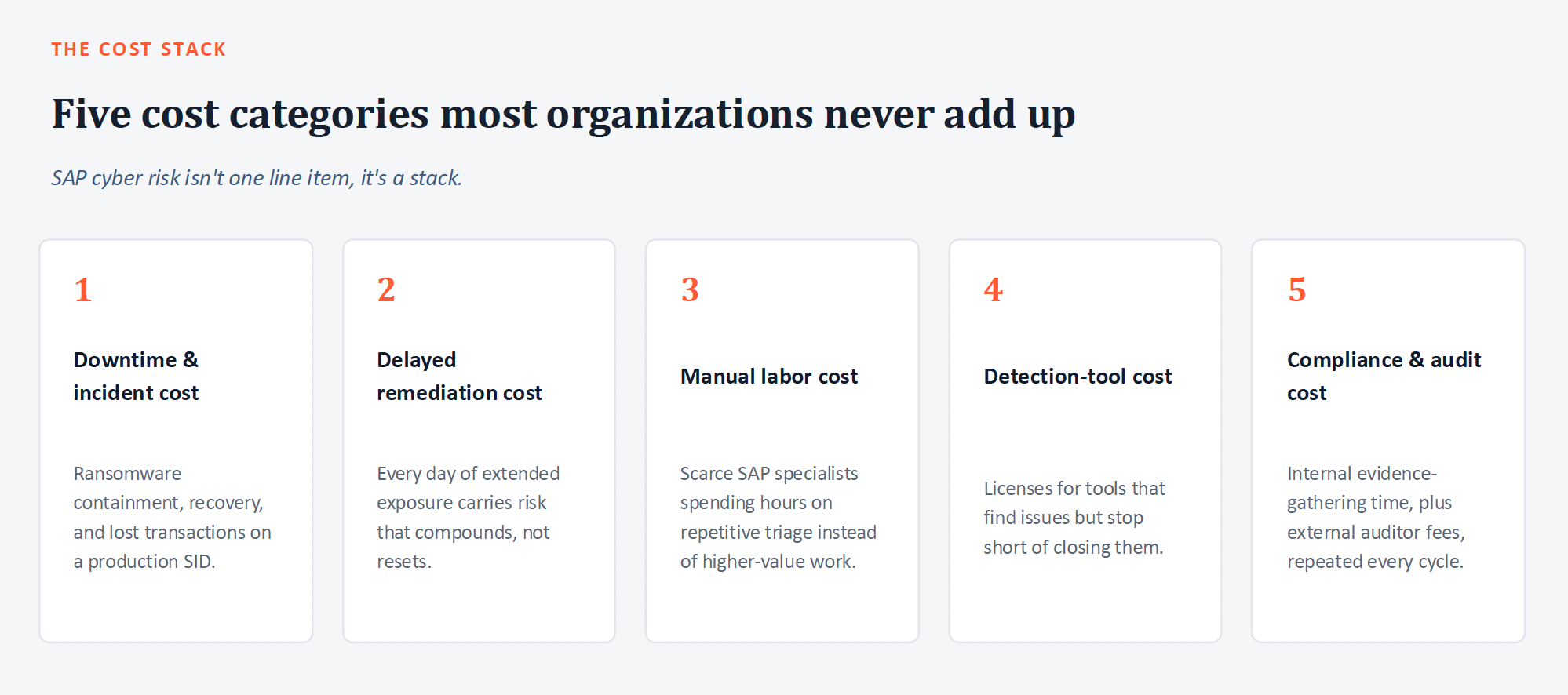
Figure 1: Hidden Costs Categories of a SAP Cyber Risk
To understand the true cost of SAP cyber risk, leaders need to account for five categories:
- Downtime and incident cost: This includes ransomware containment, recovery, lost transactions, and disruption to production systems or business processes.
- Delayed remediation cost: Every day a known issue remains unresolved extends the exposure window. It also keeps teams tied up in investigation, prioritization, testing, approval, and scheduling.
- Manual labor cost: SAP Basis, security, infrastructure, and other specialists may spend hours on triage, coordination, remediation, and validation. That is scarce capacity being pulled away from other high-value work.
- Detection-tool cost: Organizations may already be paying for tools that identify vulnerabilities or suspicious activity. The question is whether those tools help move findings toward closure or simply create another queue that people must interpret and act on manually.
- Compliance and audit cost: Evidence still has to be collected, organized, validated, and presented. That effort often repeats across compliance cycles and can involve both internal teams and external auditors.
Many of these expenses do not appear together in one place. For example, security tool may have a defined licensing cost, while the hours spent interpreting findings, identifying affected systems, coordinating with application owners, opening change requests, performing remediation, and collecting evidence are spread across multiple functions and budgets.
That makes the true operating cost easy to underestimate. Organizations may already have monitoring, vulnerability management, ticketing, security, and change-management systems, yet specialists still have to connect those systems and move each finding toward resolution.
The economic question, then, is not simply whether the organization has enough tools, but how much human effort, coordination, and time it takes before a security finding is actually closed and the risk is reduced.
Building the business case for autonomous SAP cyber operations
The webinar introduced a straightforward framework for modeling your own ROI.
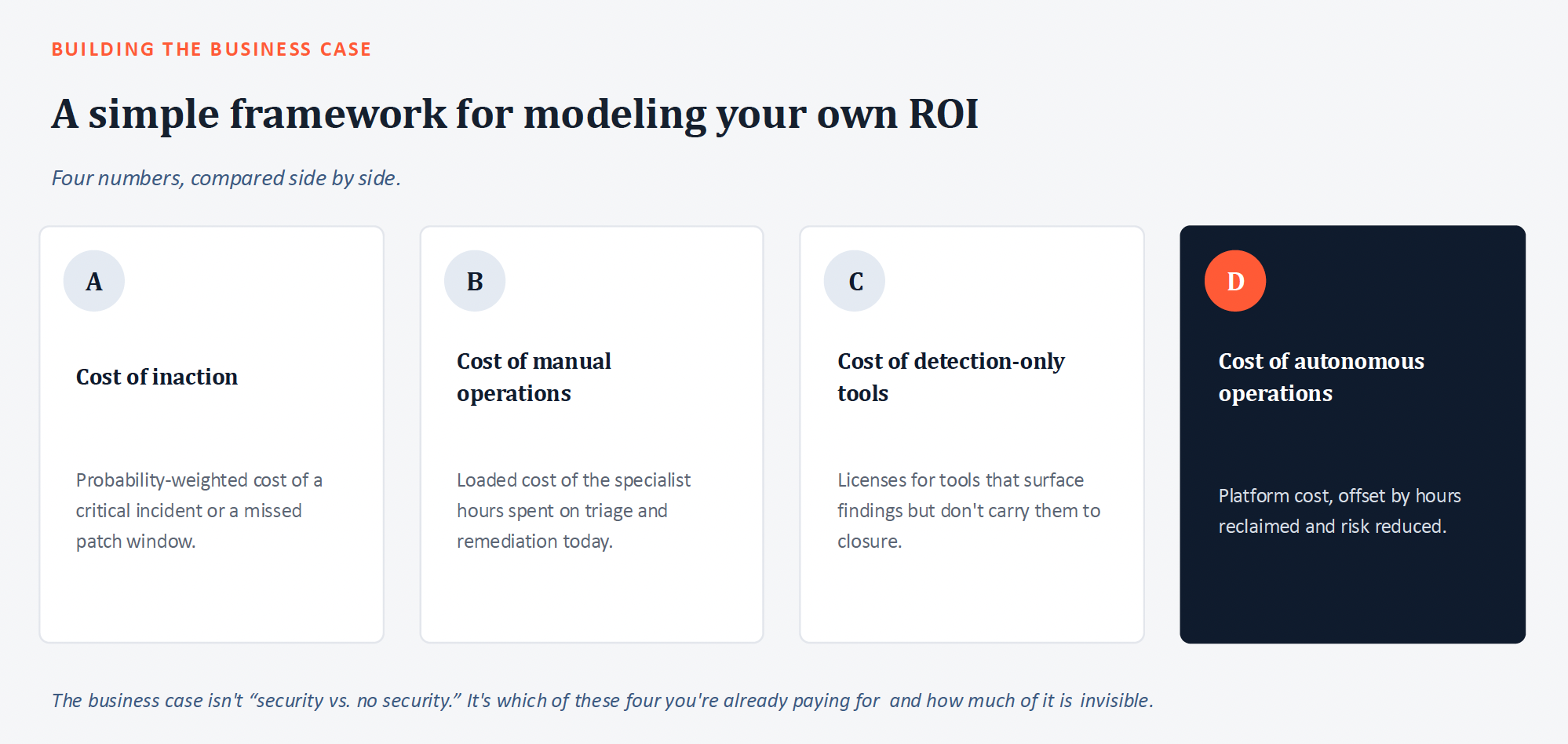 Figure 2: Framework for Modeling ROI
A strong business case examines four areas side by side: inaction, manual operations, detection-only tools, and autonomous operations.
Cost of inaction
The cost of inaction is the financial impact of leaving SAP cyber risk unresolved. It can include the probability-weighted cost of a critical incident, a missed patch window, or an exposure that remains open while teams wait for analysis, testing, approvals, or maintenance capacity.
The longer remediation is delayed, the longer the organization carries that exposure. That makes the cost of inaction something leaders should model, not treat as an abstract security risk.
Cost of manual operations
Manual operations include the specialist hours spent on triage, analysis, remediation, coordination, change management, and validation. Those hours are often spread across SAP Basis, security, infrastructure, and change management teams rather than captured in one place.
The cost also increases when work is interrupted, escalated, or repeatedly handed off between teams. Those delays stretch the remediation timeline, keep exposure open longer, and make the same finding more expensive to resolve.
Cost of detection-only tools
Detection-only tools can be valuable for identifying vulnerabilities, but their economic value is limited if the workflow stops at the finding. The license cost may be straightforward, but the downstream effort required to turn findings into remediation is much harder to see.
For executives, that changes how these tools should be evaluated. The question is not only how much visibility they provide, but whether they actually reduce the effort, delay, and operational friction required to move a finding from detection to verified closure.
Cost of autonomous operations
Autonomous operations introduce a platform and automation investment, but the comparison should account for what that operating model gives back. Governed automation can reduce specialist hours, compress remediation timelines, lower coordination overhead, and shorten the period in which known risk remains unresolved.
The economic value comes from changing how work is executed. Pre-checks, approvals, remediation, validation, and evidence capture can move through one coordinated workflow instead of being queued across multiple teams and tickets.
For executives, the question is not whether automation removes the work entirely. It is whether the organization can manage the same or greater level of cyber risk with less friction, less manual effort, and more predictable operational cost.
Demonstrating the economic value of autonomous SAP cyber operations
The economic value becomes easier to understand when you see how autonomous operations change the way teams work to get things done. Instead of relying on specialists to manually gather data, review multiple sources, correlate events, and determine what requires attention, much of that work can be handled continuously and in context.
In the webinar, Linh demonstrated how IT-Conductor SecureOps analyze SAP environments, correlate system and security data, surface key findings, and recommend follow-up actions. Watch the recording to see how that workflow works in practice and where autonomous operations can reduce manual effort, accelerate response, and free SAP specialists to focus on higher-value work.
Which metrics prove the economic value of autonomous SAP cyber operations?
To measure the economics of autonomous SAP cyber operations, leaders need to look beyond findings closed.
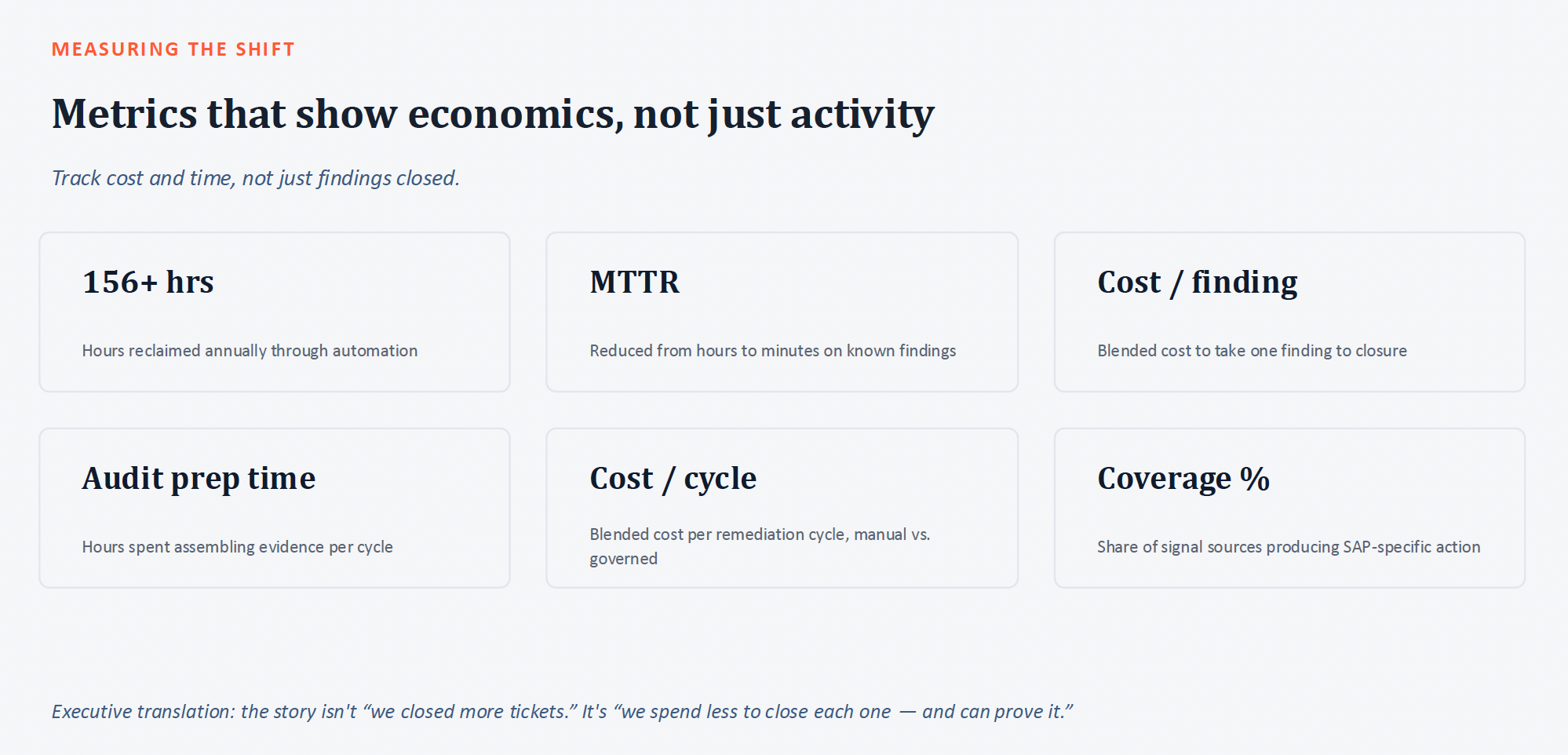 Figure 3: Metrics to Measure Economic Value of Autonomous SAP Cyber Operations
Those numbers remain useful, but they do not necessarily show whether the organization is becoming more efficient.
The webinar suggested adding measures that connect security work to time and cost:
- Hours reclaimed: specialist capacity returned through automation
- MTTR: how quickly known findings move toward resolution
- Cost per finding: the blended cost of taking one finding from identification to closure
- Audit preparation time: hours required to assemble evidence for each cycle
- Cost per remediation cycle: manual versus more automated execution
- Coverage: the percentage of relevant signal sources that produce actionable SAP-specific information
Tracking these measures changes how progress can be communicated.
Instead of reporting only that the team closed more tickets, leaders can see whether each closure required less time and whether the same available capacity can now address more risk.
That measurement also gives SAP operations teams a way to make work that is often invisible more visible. Weekend patching, manual analysis, audit preparation, coordination, and other activities become quantifiable parts of the operating model rather than effort hidden behind a completed change request.
Key Takeaway
The economics of autonomous SAP cyber operations comes down to making the cost of security work visible.
Organizations already spend money responding to vulnerabilities, maintaining compliance, operating security tools, coordinating specialists, handling downtime, and managing the exposure created when remediation takes longer than expected.
Autonomy provides an opportunity to change those economics by reducing the human effort and process friction required to move from a finding to a validated outcome.
The objective is not simply to spend less on security. It is to show more clearly what the existing security budget accomplishes: how many specialist hours it returns, how quickly it reduces exposure, how much recurring manual work it removes, and how much risk the organization can address within its available capacity.
As Linh summarized in the webinar, the shift gives executives a different way to view cybersecurity investment. Security spend can begin to map to hours reclaimed and risk reduced, while the cost of inaction becomes something organizations model before an incident rather than calculate afterward.
Your SAP security program already has a cost. The next step is understanding where that cost comes from and what governed automation could change in your environment.
Request an assessment to baseline your manual effort, tool spend, and exposure and begin modeling the economics of autonomous SAP cyber operations.
