On September 9th, we hosted a webinar exploring how SAP teams can move from periodic compliance audits to continuous cyber resilience.
Compliance frameworks provide organizations with a foundation for managing cybersecurity risks. They define policies, controls, testing requirements, and the evidence needed to show that security measures are in place and effective. However, compliance reviews capture only a point in time, while conditions in SAP can change at any moment. New Security Notes, configuration changes, or excessive privileges can introduce exposure before the next review, widening the gap between compliance and cyber resilience.
In the ninth session of the Rise of SAP Autonomous Cyber Operations webinar series, IT-Conductor CEO Linh Nguyen explored this gap, focusing on how organizations can move beyond periodic compliance exercises toward continuous validation, remediation, and reporting, with SAP cyber operations continuously validating controls and capturing evidence, so compliance becomes an outcome of day-to-day security operations rather than a periodic exercise.
Why periodic compliance review is not enough for SAP cyber resilience
Periodic compliance reviews can confirm that controls were in place and operating at the time of assessment, but they provide only a point-in-time view. They do not continuously show whether those controls remain effective as the SAP environment and its risk posture change between reviews. The webinar captured this distinction by framing it simply: compliance asks, “Can we demonstrate control?” while resilience asks, “Are controls working right now?”
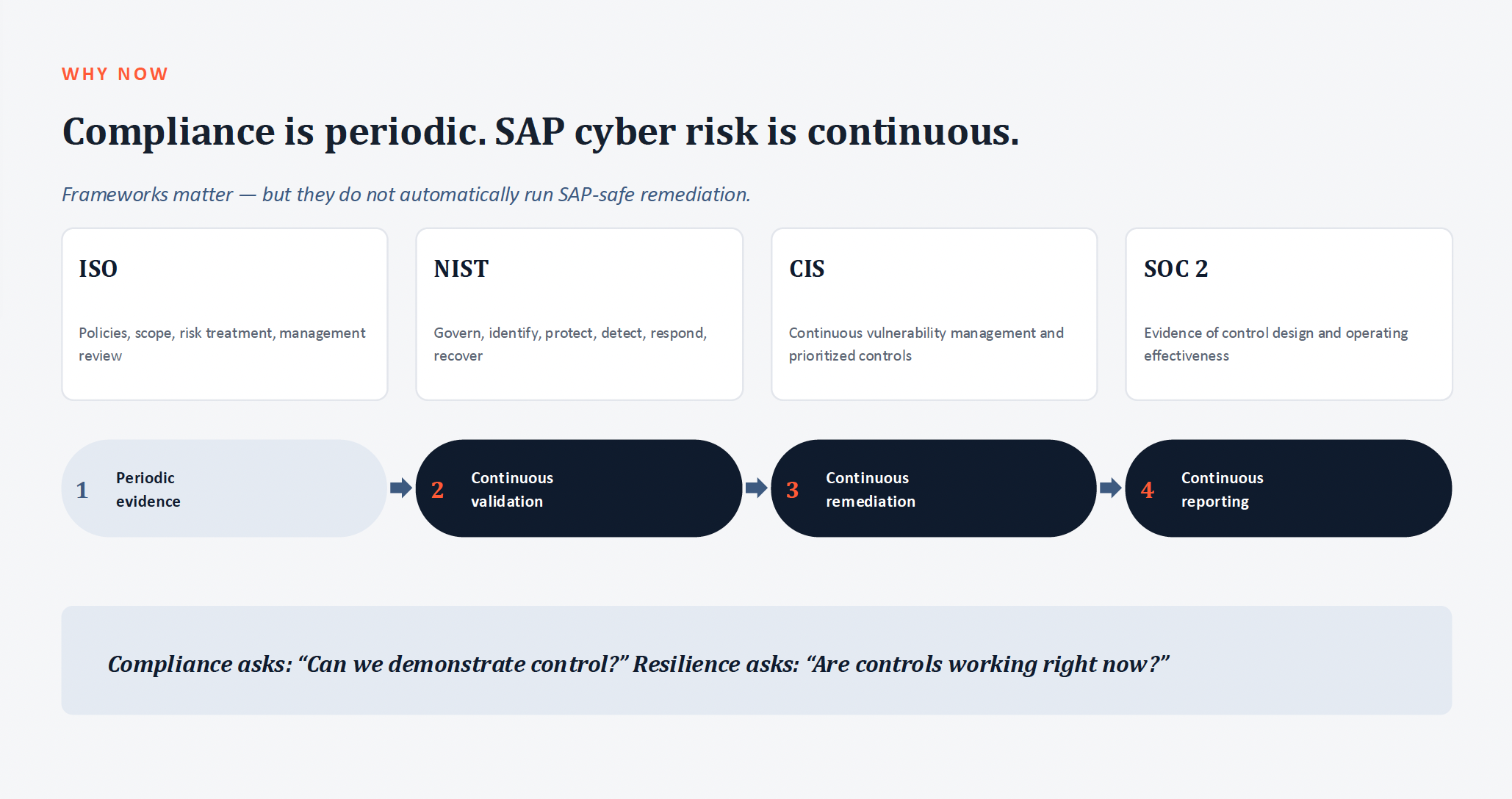
Figure 1: Compliance Frameworks vs SAP Cyber Resilience
Frameworks such as ISO, NIST, CIS, and SOC 2 provide the structure for cybersecurity policies, controls, risk treatment, and evidence. In SAP environments, however, those requirements become actionable only when they are mapped to the systems, components, risks, and change conditions they affect. This SAP-specific context helps teams continuously validate control status and determine whether a finding should be remediated, compensated for, escalated, deferred, or closed.
Continuous cyber resilience turns these activities into an ongoing operating model. Rather than waiting for the next compliance review, teams continuously validate controls, address gaps, and capture evidence through day-to-day SAP cyber operations, keeping both risk and assurance current as conditions change.
How compliance, security, and SAP teams work together for continuous SAP cyber resilience
Continuous SAP cyber resilience depends on GRC and audit teams, security teams, and SAP Basis and platform teams working from the same source of truth. GRC and audit teams need evidence that controls are operating effectively, along with clear control mappings, documented exceptions, assigned ownership, and trend reporting. Security teams need SAP-specific context to assess risk and determine the appropriate response, while SAP Basis and platform teams need applicability, prioritization, change windows, pre-checks, and rollback options to remediate safely.
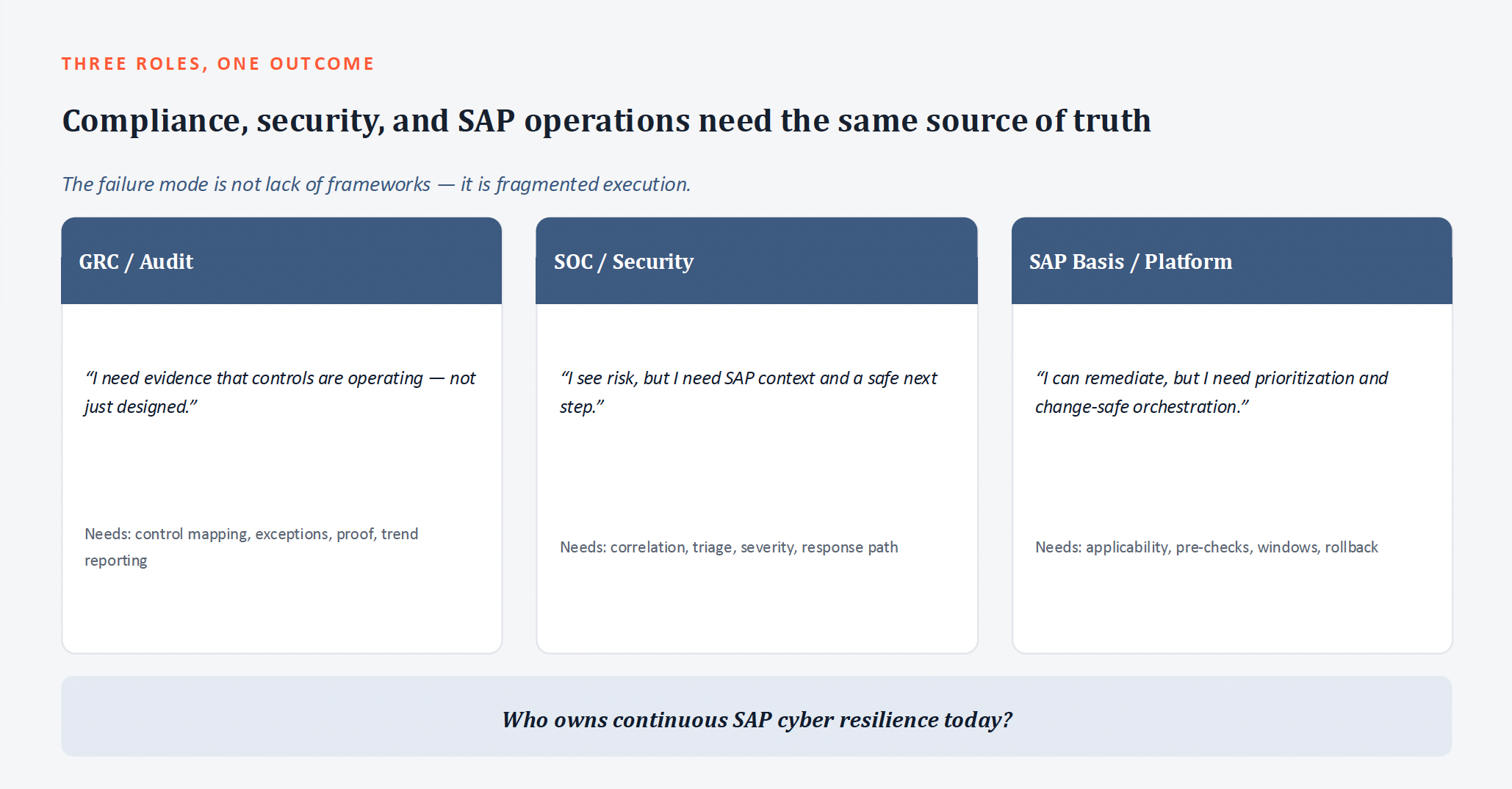 Figure 2: Teams Supporting SAP Security
Although each team has different responsibilities, they share the same goal: keeping SAP environments secure, compliant, and resilient. The challenge is maintaining that alignment across control requirements, SAP signals, risk assessment, remediation, and proof. When these activities are fragmented across teams and tools, findings can lose context or stall before action is taken.
A continuous operating model helps keep these teams aligned around the same risk information, decisions, and evidence. Each team can contribute according to its responsibilities while working from a shared view of the SAP environment, reducing fragmented handoffs and helping security, compliance, and remediation efforts move toward the same outcome.
How continuous cyber resilience changes SAP audit readiness
Traditional compliance often relies on periodic assessments, manual evidence collection, point-in-time remediation status, and exception tracking after the fact. Continuous cyber resilience changes that model by keeping control validation, remediation, and evidence capture active as part of day-to-day SAP operations.
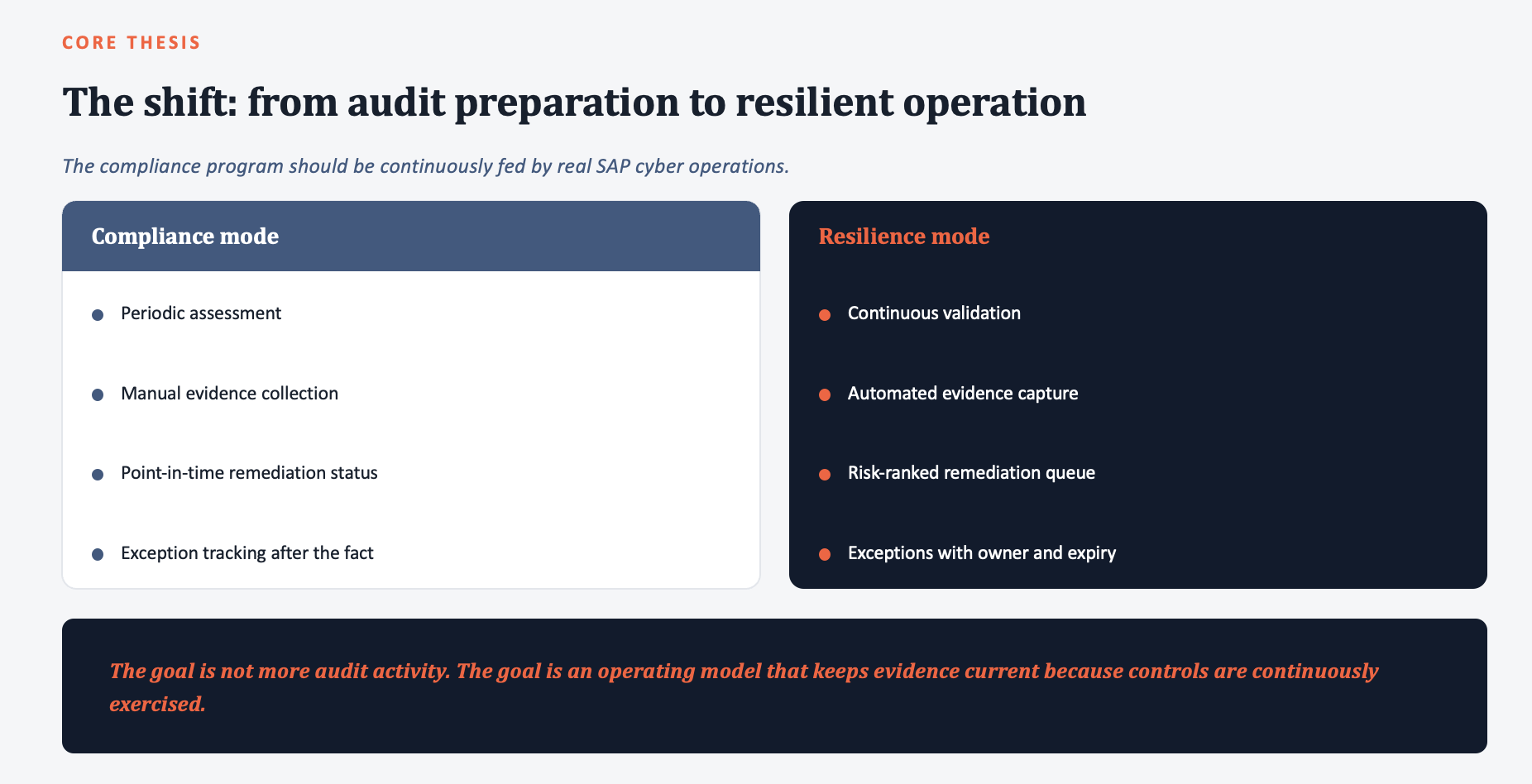 Figure 3: From Audit Preparation to Resilience Operation
Instead of rebuilding the history of a change when an audit approaches, teams can capture evidence as the work happens. Approvals, pre- and post-checks, execution logs, validation results, ownership, exception status, and closure records can all become part of the workflow, helping keep compliance evidence current.
This shifts compliance from a periodic exercise to maintaining ongoing audit readiness. Controls are validated as conditions change, remediation is prioritized by risk, exceptions remain tied to owners and expiry dates, and supporting evidence stays current because it is generated as part of the workflow.
How SACO turns compliance requirements into SAP-aware operational decisions
Compliance frameworks may define requirements for patch management, access controls, logging, monitoring, and other security objectives. But those requirements do not determine what should happen in a specific SAP environment until they are mapped to SAP context such as the SID and client, kernel or component level, business criticality, current configuration, exposure, change window, and existing controls.
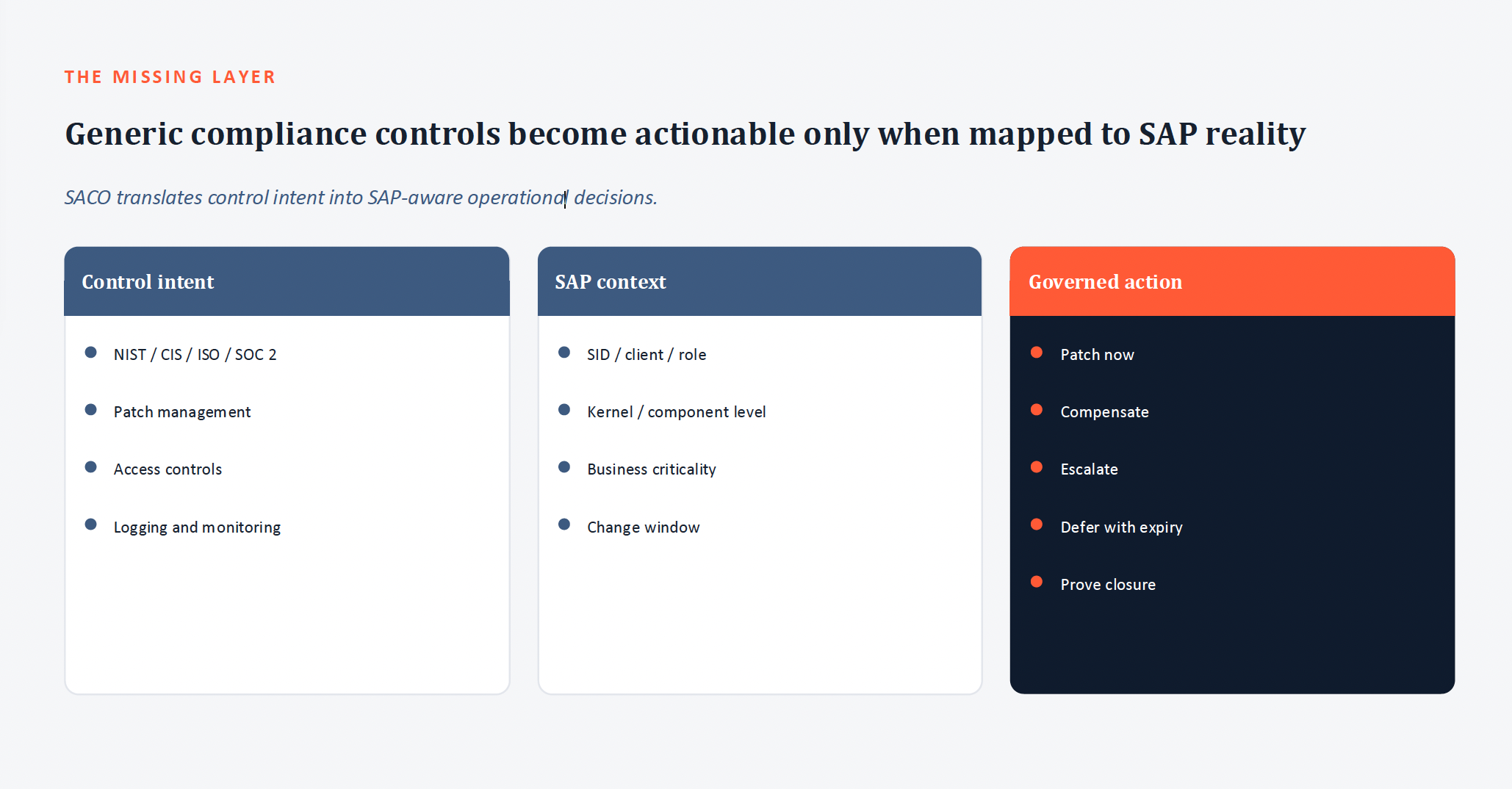 Figure 4: The Missing Layer: SACO
As part of SAP Autonomous Cyber Operations (SACO), this mapping helps translate control intent into SAP-aware operational decisions. With the right context, teams can determine whether the appropriate response is to patch, apply a compensating control, escalate for expert review, defer with an expiry date, or prove that the finding is not applicable or already resolved.
The continuous cyber resilience operating model
We first introduced the broader detection-to-remediation framework in our previous webinar, Detect. Decide. Remediate., and have revisited the same operating model from different angles throughout the webinar series. Depending on the topic, certain stages have received more emphasis, but the underlying principle remains the same: SAP cyber risk should move through a governed, continuous process.
For this webinar, the discussion centered on three capabilities that are especially important for moving from periodic compliance to continuous cyber resilience: continuous validation, continuous remediation, and continuous reporting. Together, they help organizations determine whether controls are still effective, address gaps as they emerge, and keep evidence current as part of normal SAP cyber operations.
Continuous validation
Continuous validation checks the current state of controls across the SAP platform, configuration, application, and IAM layers.
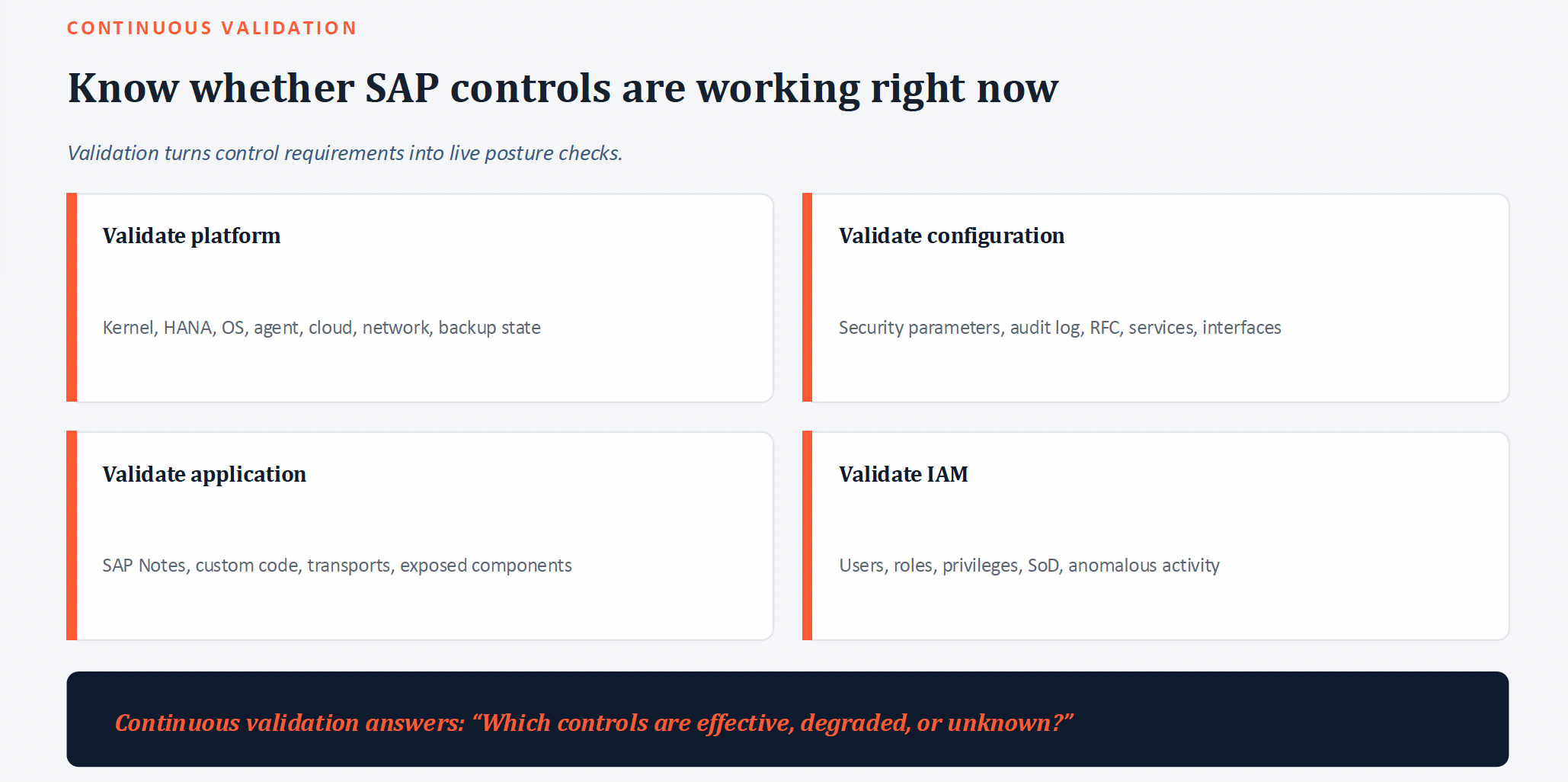 Figure 5: Continuous Validation
At the platform level, this can include the kernel, HANA, operating system, cloud, network, and backup state. Configuration checks can cover security parameters, audit logging, RFC connections, services, and interfaces, while application and IAM checks can extend to SAP Notes, custom code, transports, users, roles, privileges, segregation of duties, and anomalous activity.
Taken together, these checks give teams a current view of control status across the SAP environment. By showing which controls are effective, degraded, or unknown, continuous validation provides a clearer basis for determining where remediation or further review may be required.
Continuous remediation
Continuous remediation ensures that validated security gaps move toward an appropriate response rather than waiting for the next audit or review cycle. Within the SACO model, a finding can follow different governed action paths depending on its applicability, exposure, operational constraints, and policy boundaries.
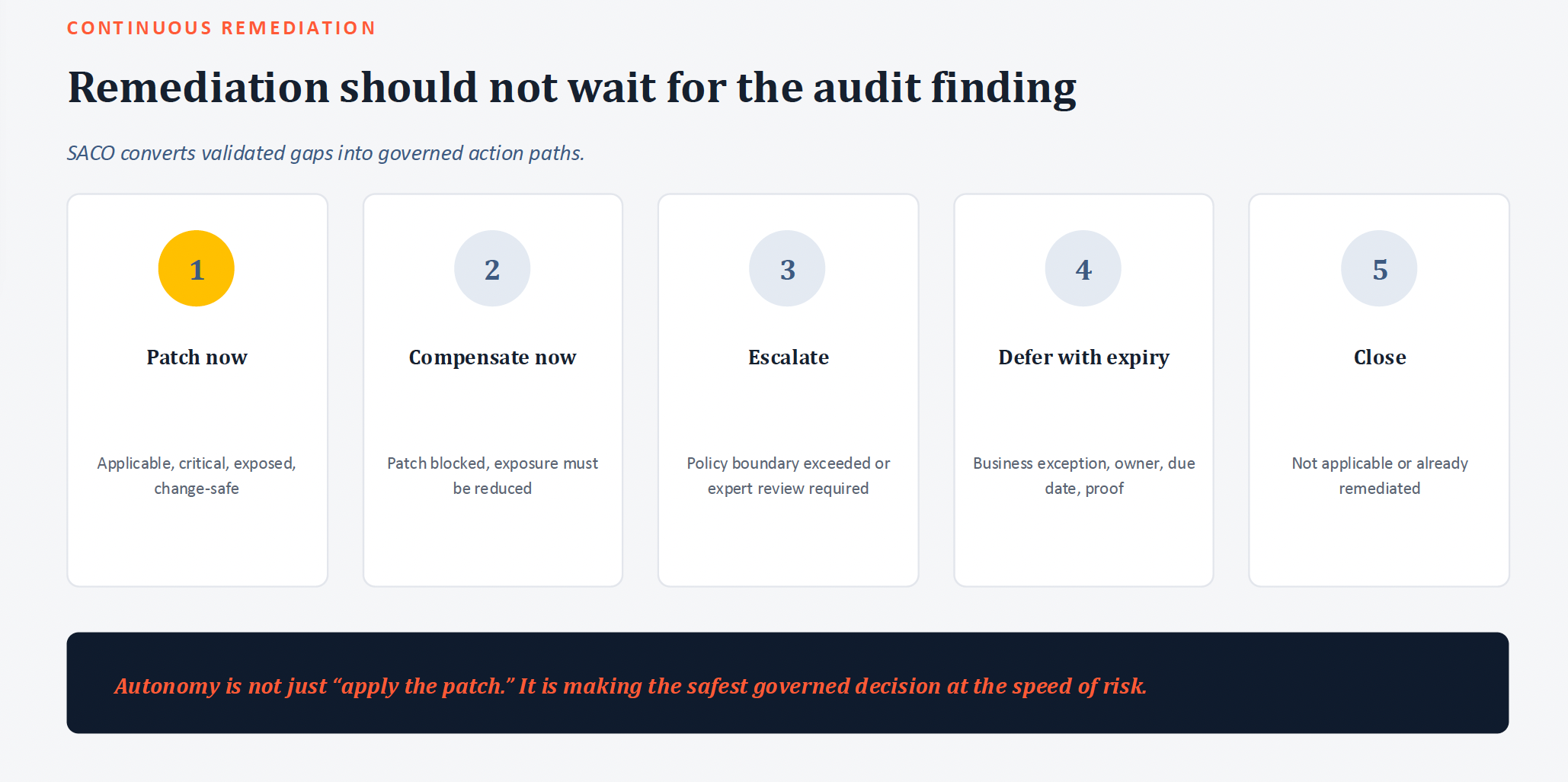 Figure 6: Continuous Remediation
An applicable and exposed vulnerability may warrant immediate patching. When patching cannot occur immediately, teams may reduce exposure through a compensating control. Findings outside predefined decision boundaries can be escalated, while business exceptions can be deferred with an owner, due date, and supporting evidence. Findings that do not apply or have already been remediated can be closed.
The important point is that autonomy does not simply mean automatically applying every patch. Governed autonomy keeps each decision within defined policy boundaries, using approvals and escalation where needed to support timely remediation without compromising operational control.
Continuous reporting
Continuous reporting completes the resilience loop by turning operational activity into current, usable evidence. Rather than waiting until an audit to reconstruct what happened, teams can capture the information needed to show how a finding was assessed, what action was taken, and whether the issue was fully resolved.
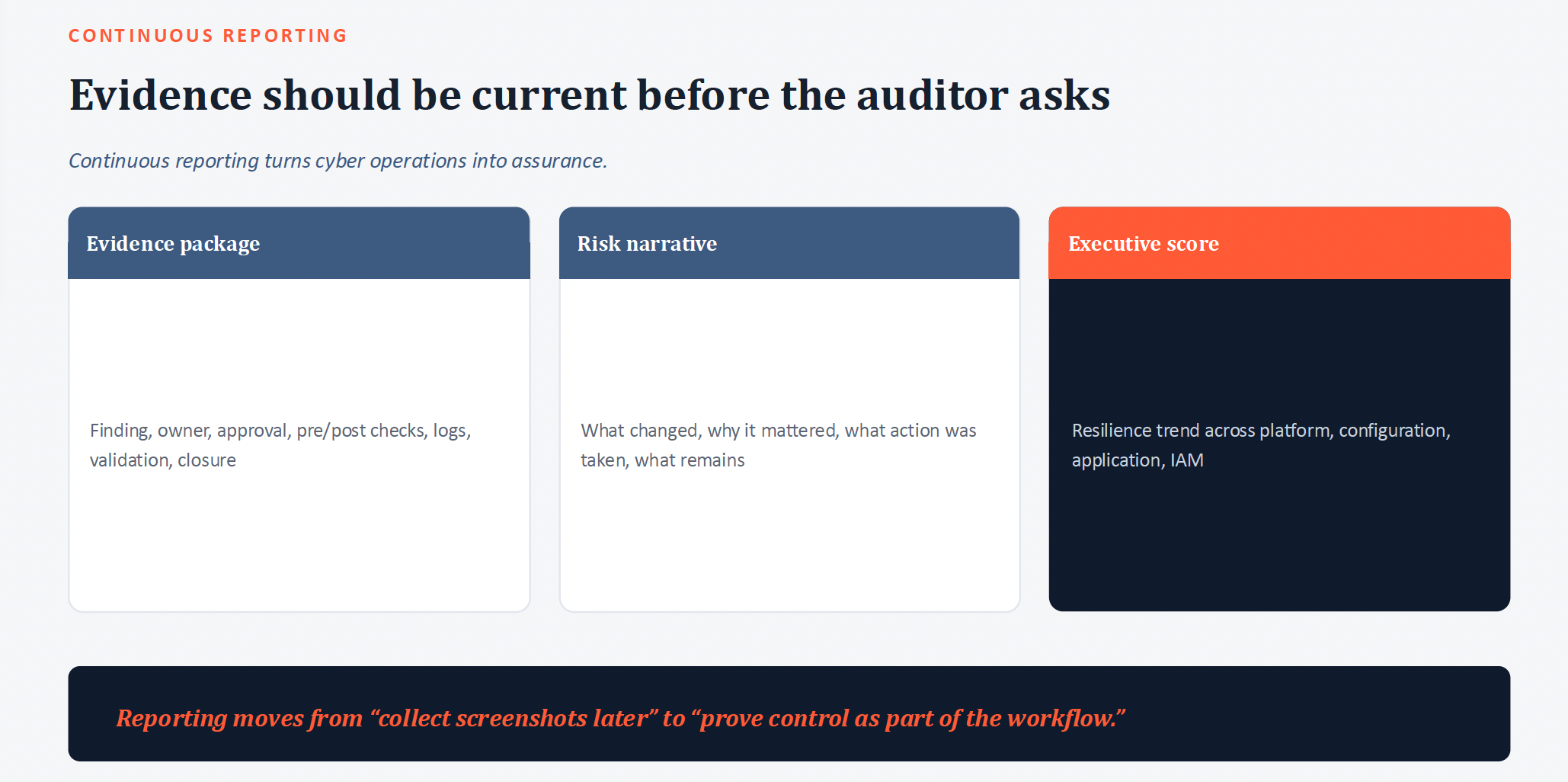 Figure 7: Continuous Reporting
Each finding can build an evidence package that includes the owner, approvals, pre- and post-checks, execution logs, validation results, and closure status. Reporting can also provide the broader risk narrative by showing what changed, why it mattered, what action was taken, and what exposure remains.
Executives do not need the details of every SAP Security Note. They need to understand trends such as exposure, remediation progress, exception aging, and whether completed actions can be proven.
At the executive level, this information can be reflected in resilience trends across platform, configuration, application, and IAM. This gives leaders a current view of how SAP cyber resilience is changing over time, while evidence such as findings, approvals, logs, validation, and closure records remains available to support compliance and audit requirements.
Continuous cyber resilience in practice
During the demo, Linh brought the operating model into practice through three use cases: Patch Tuesday control validation, continuous audit readiness, and executive cyber resilience scoring. Together, they illustrated how findings can move from applicability and remediation decisions to evidence capture and a current view of resilience across the SAP environment. Rather than walking through every step here, the full demonstration in the webinar shows how these capabilities come together in IT-Conductor SecureOps.
Following the demo, Linh emphasized that events such as Patch Tuesday or an audit should be treated as triggers for a continuous cycle rather than one-time exercises. Some findings may be resolved quickly, while more complex remediation can extend across weeks or months; what matters is that the finding, decision, remediation or compensating control, exception, and resulting change in resilience continue to be tracked. This allows organizations to show progress over time while producing evidence that can support compliance when it is needed, rather than reconstructing that history later.
Metrics to measure continuous cyber resilience
Moving to continuous cyber resilience also changes what teams measure. Instead of focusing primarily on whether compliance activities were completed, teams can track how quickly SAP-relevant risks are identified, assessed, decided on, and remediated or compensated, along with whether the supporting evidence is complete.
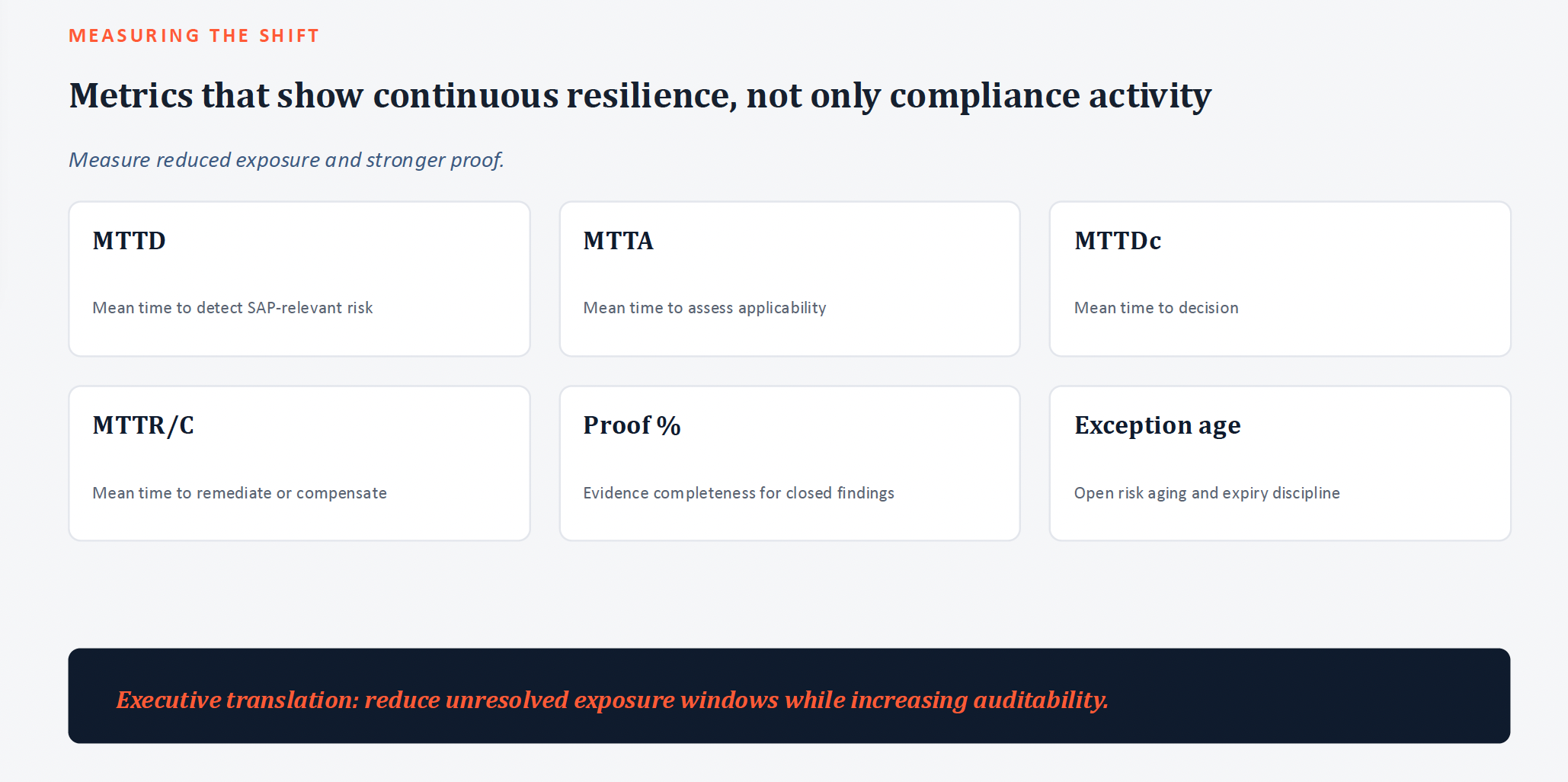 Figure 8: Continuous Cyber Resilience Metrics
The following metrics cover the full lifecycle of a finding:
- Mean time to detect (MTTD): Time required to identify SAP-relevant risk.
- Mean time to assess applicability (MTTA): Time required to determine whether a finding applies to the SAP environment.
- Mean time to decision (MTTDc): Time required to determine the appropriate response.
- Mean time to remediate or compensate (MTTR/C): Time required to remediate the finding or reduce exposure through a compensating control.
- Proof %: Completeness of the evidence associated with closed findings.
- Exception age: How long open risks and approved exceptions remain unresolved, including whether expiry dates are being managed appropriately.
A 30-day action plan to continuous cyber resilience
The webinar closed with a practical 30-day action plan for organizations looking to make SAP cyber resilience more continuous and measurable, particularly those still relying largely on periodic compliance activities.
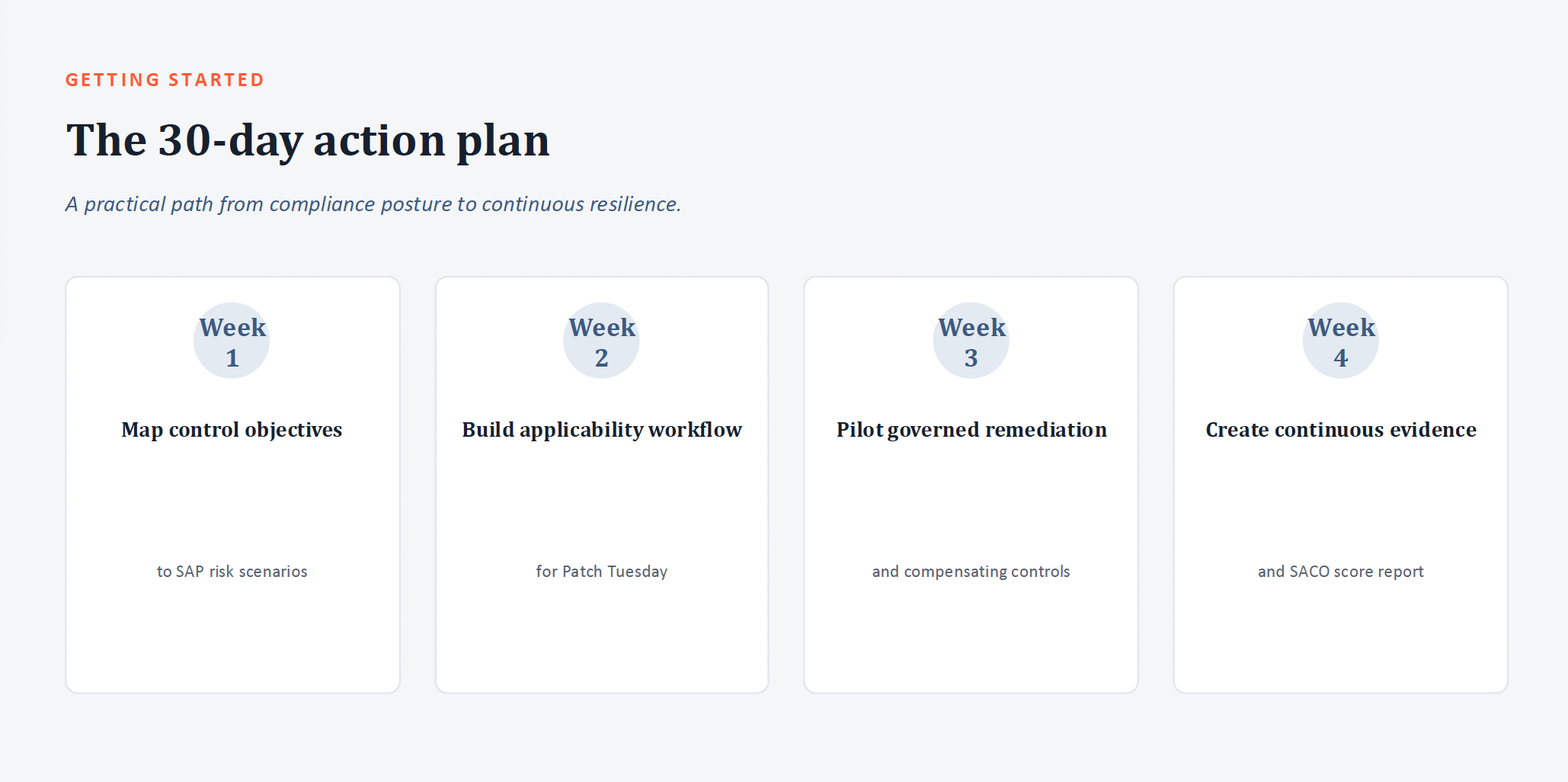 Figure 9: 30-Day Action Plan to Continuous Cyber Resilience
The first week focuses on mapping compliance objectives to relevant SAP risk scenarios, followed by building an applicability workflow around Patch Tuesday. From there, teams can pilot governed remediation and compensating controls, then establish continuous evidence capture and SACO score reporting.
Linh also emphasized that organizations do not need to reach their desired level of resilience all at once. A practical starting point is to understand where findings fall across the different security pillars, establish a baseline, and identify which improvements are achievable based on factors such as effort and downtime. Progress can then be made in phases, with teams continuing to track how remediation changes their resilience over time.
For organizations accustomed to periodic reviews, this creates a more sustainable path forward. Instead of rebuilding evidence around each audit cycle, teams can make validation, governed remediation, exception tracking, and evidence capture part of day-to-day SAP cyber operations, gradually turning compliance from a point-in-time exercise into a continuous resilience capability.