Understand what the Wiz acquisition means for enterprise security, AI governance, and risk management across hybrid and distributed environments.
AI governance and security is becoming an enterprise-wide priority as AI initiatives move from experimentation to production. Organizations are moving beyond exploring chatbots and simple generative AI productivity use cases. AI is now becoming part of core enterprise workflows, where it can access data, interact with systems, and influence decisions across cloud, security, IT, and business operations.
As organizations advance toward autonomous operations, AI applications must be governed, monitored, and secured with the same rigor as other business-critical systems. Security teams need to know where AI is running, what it can access, and whether it is behaving as intended.
Google’s recent acquisition of Wiz reflects the growing demand for AI governance and security that works across cloud, data, identity, and application environments.
In this article, we’ll look at what the acquisition means for enterprise security, why AI application risks require more context, and how organizations can move from detection to remediation as AI becomes part of autonomous operations.
Wiz acquisition as a catalyst for stronger AI governance and security
Bringing Wiz into Google’s portfolio through its largest acquisition of $32 billion says a lot about where enterprise security is heading and how serious Google thinks cybersecurity is in business. As AI becomes more embedded in cloud environments, security teams need better ways to understand the workloads, identities, data, and runtime behaviors that support AI applications.
Wiz has emerged as one of the fastest-growing cloud security platforms by providing a unified view of cloud infrastructure, identities, workloads, vulnerabilities, and exposures across multi-cloud environments. Google's acquisition reflects the industry's shift toward security platforms that can correlate risk across cloud, data, identity, and AI-driven workloads.
AI applications raise the stakes for cloud security because they often depend on connected services, APIs, permissions, data sources, and automation layers. A single misconfiguration, exposed endpoint, or overprivileged identity can become more serious when tied to an AI workflow.
The Wiz acquisition also points to the growing need for tools that can provide context to the AI risk signals received from different sources. Security teams need to understand whether an alert is tied to an exposed endpoint, an overprivileged identity, a sensitive data source, or an AI workflow with access to critical systems. Without that context, AI governance becomes harder to enforce in production environments. Policies may define how AI should be developed and used, but enterprises still need operational visibility to detect risky configurations, suspicious behavior, and unauthorized access as AI applications evolve.
Context also helps enterprises move from detection to remediation. Instead of treating every AI-related alert the same way, security teams can prioritize issues based on exposure, data sensitivity, permissions, and business impact, then apply the right fix before the risk spreads across production environments.
Why enterprises need to define AI application risks first
Before enterprises can govern and secure AI effectively, they need a clear understanding of what AI application risks actually include. The Wiz acquisition reinforces the need for broader security context, but that context only becomes useful when teams know what they are looking for across AI-enabled environments.
What are AI application risks?
AI application risks are the security, privacy, operational, and governance risks that arise when artificial intelligence is embedded into enterprise systems and business workflows. It can come from every layer supporting the application, including cloud infrastructure, identities, permissions, APIs, data sources, prompts, agents, Model Context Protocol (MCP) servers, and third-party integrations. These risks can include sensitive data exposure, prompt injection, excessive permissions, unauthorized agent actions, public exposure of AI endpoints, insecure MCP server access, weak monitoring, and poor governance across the AI lifecycle.
Understanding AI application risks in SAP operations
In a traditional SAP environment, SAP Basis teams or SAP Security teams usually manage user access, monitor transactions, enforce Segregation of Duties (SoD) controls, and govern system behavior through established roles, authorizations, and approval processes. AI applications introduce a more dynamic layer. They can interpret prompts, retrieve information, call tools, use APIs, and generate outputs based on changing business and system context.
When AI agents are introduced into SAP operations, the risk becomes more complex. An AI agent may not only summarize information or recommend actions. It may also support remediation workflows, trigger operational tasks, interact with SAP systems, or connect with surrounding cloud and application environments. If these actions are not properly governed, an AI workflow could unintentionally increase access risk, expose sensitive business data, or affect critical SAP processes.
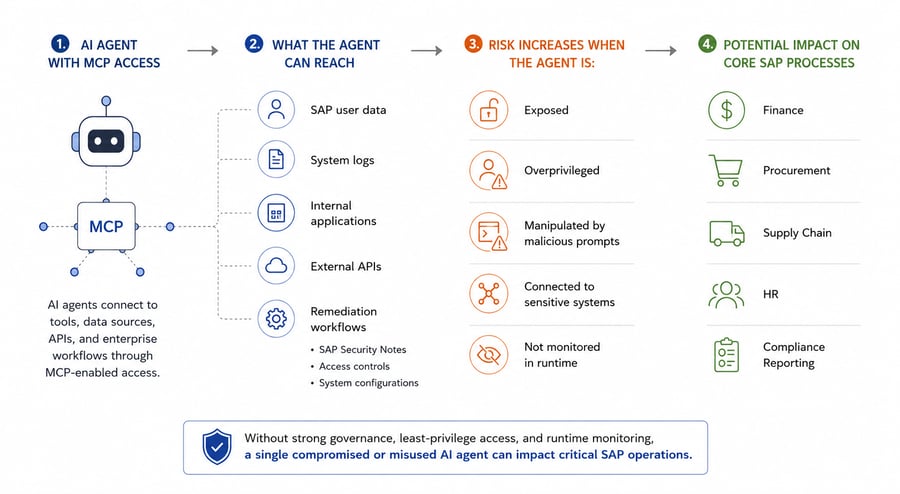 Figure 1: AI Agents in SAP Operations
For example, an AI agent with MCP access may be able to retrieve SAP user data, review system logs, interact with internal applications, call external APIs, or support remediation activities related to SAP Security Notes, access controls, or system configurations. If that agent is exposed, overprivileged, or manipulated through a malicious prompt, the impact could extend into business-critical processes such as finance, procurement, supply chain, HR, or compliance reporting.
This is why SAP-centric enterprises must ask practical security questions before and after deploying AI applications:
- Where is AI running across our SAP and connected enterprise environments?
- Can this exposed MCP server access SAP data, user records, logs, or sensitive business information?
- Is this AI agent performing actions outside its approved SAP security or operations workflow?
- Which SAP roles, identities, permissions, APIs, and tools are connected to this AI application?
- Are suspicious prompts, unusual access patterns, or unauthorized tool calls being detected?
- Are guardrails in place to limit unsafe behavior and require approval for high-risk remediation actions?
These questions help define the foundation of AI governance and security in SAP environments.
As AI becomes part of SAP operations, enterprises need clear visibility, controlled access, runtime monitoring, and auditable remediation workflows to ensure AI supports the business without introducing new risks.
Bringing cyber resilience into autonomous operations
AI governance and security are becoming part of the day-to-day reality of running enterprise systems. As AI moves into production, teams need to go beyond policies and planning with clear visibility into where AI runs, what it can access, how it behaves, and how risks are addressed.
For SAP teams, the same challenge shows up in a very practical way. Security findings, missing patches, access risks, system anomalies, and remediation tasks often involve multiple teams and manual handoffs.
But what if AI agents could help SAP teams move from detecting risks to remediating them, without losing control, approval, or auditability?
On June 24th, we’re hosting a webinar “Autonomous Cyber Resilience for SAP Operations” to showcase IT-Conductor Maestro and demonstrate how it helps SAP teams coordinate security response, remediation, and recovery through autonomous, audit-ready workflows.
Save your seat and explore how agentic AI level up SAP security operations.