An autonomous SAP Security Operations Center (SOC) becomes necessary when security teams can detect threats but still struggle to understand what those signals mean for SAP. As we have discussed throughout the Rise of SAP Autonomous Cyber Operations webinar series, most organizations already have plenty of sources for detecting suspicious activity and identifying vulnerabilities, from SIEM and EDR to identity platforms and cloud security tools. These tools can tell teams that something is wrong, but they do not always provide enough SAP-specific context to determine how a finding relates to the actual landscape, which systems or interfaces are affected, what business processes may be at risk, and what action should follow.
In this webinar, IT-Conductor CEO Linh Nguyen used the recent CenterPoint Energy cybersecurity incident to show how quickly an external compromise can raise questions about backend systems and data. The scenario helped frame the broader challenge: once a security event is detected, teams still need to determine what it means for their environment and coordinate the appropriate response. He then explored how organizations can build a more autonomous security operations model that brings together security signals, SAP context, AI-assisted analysis, risk-based decisions, governed automation, and remediation.
Which IT roles are responsible for addressing security events today?
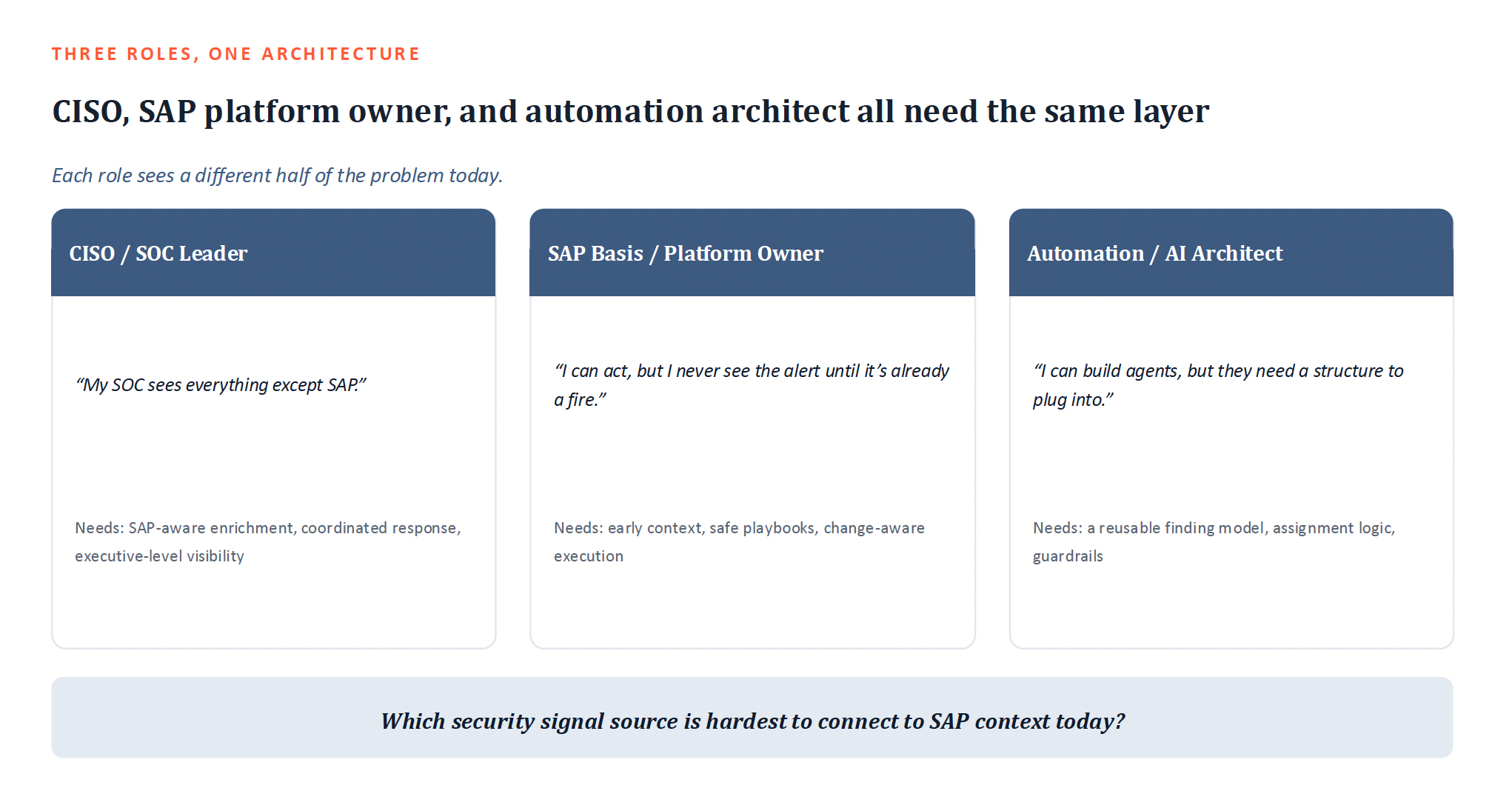
Security events rarely fall under a single team. Different roles see different parts of the problem, depending on the tools they manage, the systems they understand, and the actions they are authorized to take.
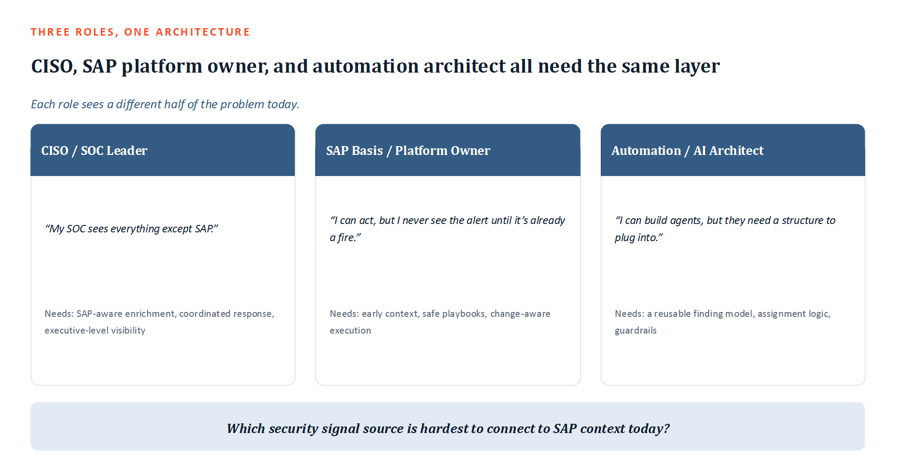 Figure 1: Common IT roles involved in SAP Security
In the webinar, Linh highlighted three roles that often share responsibility for responding to security events:
-
- CISO or SOC Leader: Has broad visibility across enterprise security tools, including alerts, vulnerabilities, and other indicators of risk. Their challenge is understanding how those signals relate to critical systems and whether the organization is sufficiently protected.
- SAP Basis or Platform Owner: Has deeper knowledge of the SAP landscape and understands the technical dependencies involved in making changes. However, they may only become aware of a security issue after it has been identified and passed along by another team. They need enough context to determine what is affected, how urgent the issue is, and what action can be taken safely.
- Automation or AI Architect: Focuses on how agents, workflows, and automation can support the response. Their role is to connect analysis and execution through reusable processes while ensuring those capabilities operate within defined policies, approval requirements, and operational boundaries.
Each role contributes a different part of the response. The CISO or SOC leader may see the security signals first, while the SAP Basis team or platform owner understands how those signals relate to the SAP landscape and what changes can be made safely. At the same time, automation and AI capabilities can help bring analysis and execution together so teams do not have to rebuild the response process for every new finding. Linh described the goal as creating reusable orchestration that can help detect issues, support decisions, and execute the appropriate actions.
What does the architecture of an autonomous SAP Security Operations Center look like?
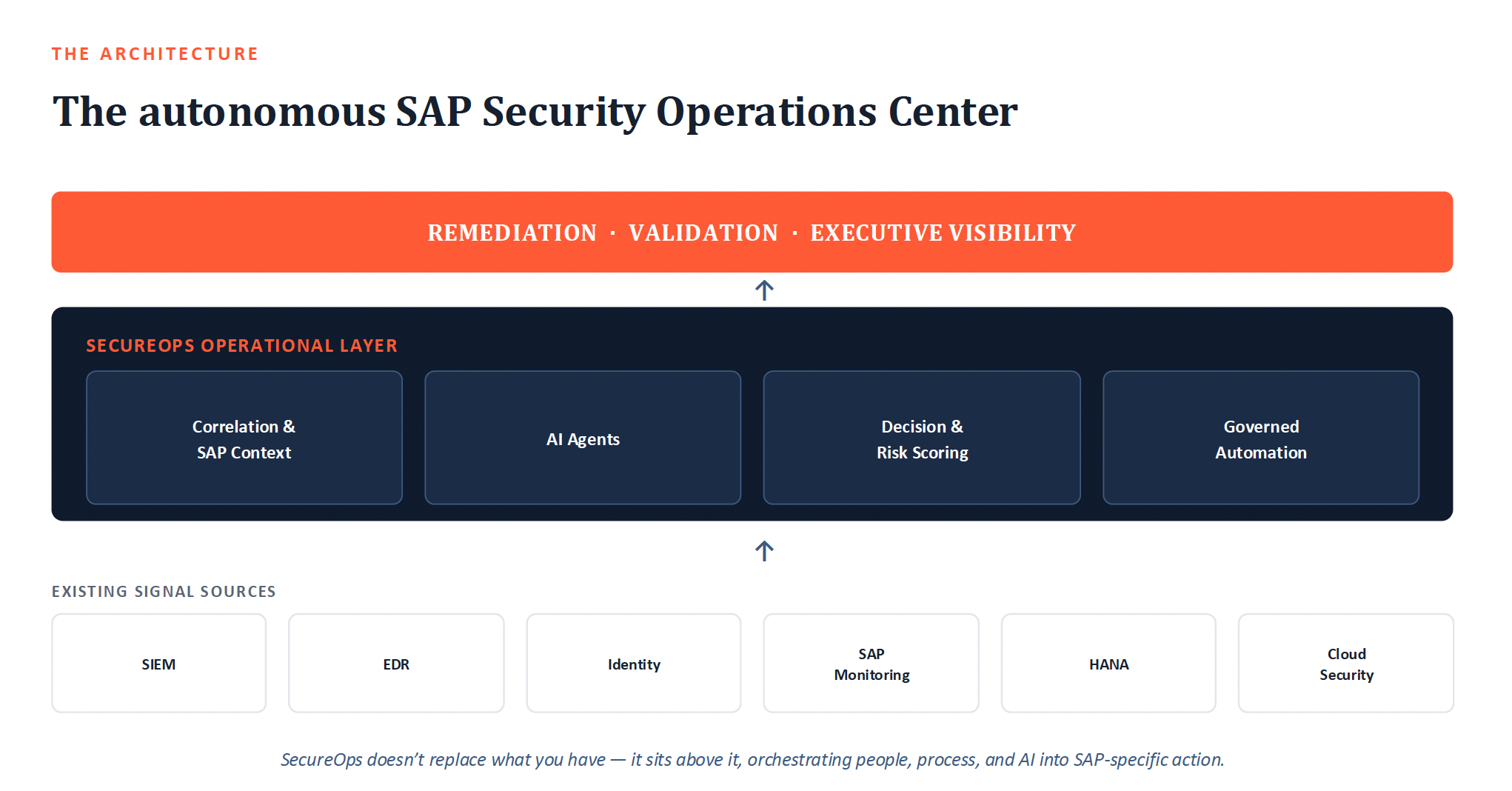
The architecture behind an autonomous SAP Security Operations Center integrates existing security tools and SAP-specific telemetry to a common operational layer for correlation, context, decision-making, governed automation, and remediation.
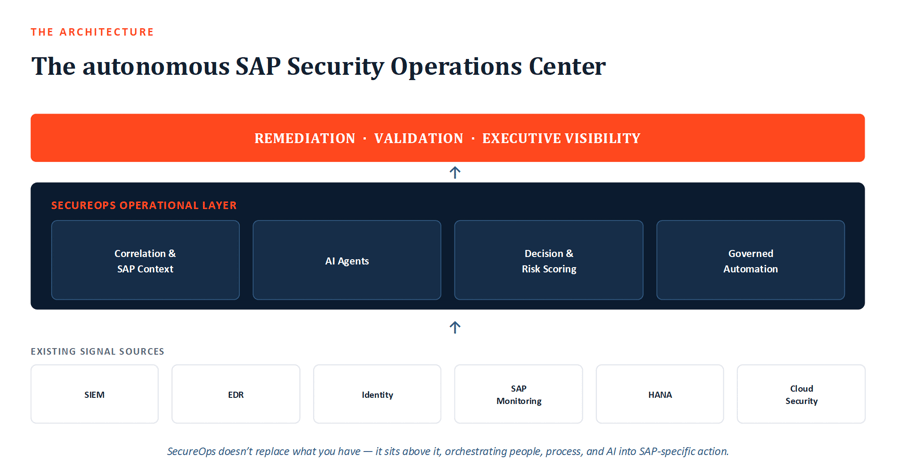 Figure 2: Architecture behind Autonomous SAP Security Operations Center
IT-Conductor SecureOps provides the orchestration layer for bringing context and dependencies together, assessing risk, routing findings to the appropriate team, and triggering remediation workflows. Rather than replacing tools such as SIEM, EDR, vulnerability scanners, SOAR, or CMDBs, it brings their signals and data together so teams can understand what a finding means for the SAP landscape and what action should follow.
Detection sources
SAP security findings can come from several sources, including SIEM alerts, SAP Security Notes, CVE feeds, configuration checks, and performance anomalies. These signals may point to issues across the operating system, database, access controls, or infrastructure. In autonomous operating model, findings from different sources are brought together so teams can evaluate them in context instead of treating each alert separately.
Risk scoring
Each finding is graded and scored based on its impact and relevance to the environment. As new findings are identified or existing issues are remediated, the overall security or resilience score changes accordingly. This gives teams a clearer way to prioritize findings and focus on the areas that can have the greatest effect on the current posture.
Effort estimation
Each remediation item can also include an estimated level of engineering effort. These estimates help teams understand the resources required to address findings and plan remediation work alongside available capacity and downtime. Over time, those estimates can be refined based on actual execution and adjusted when needed.
How should ownership be organized in an autonomous SAP SOC?
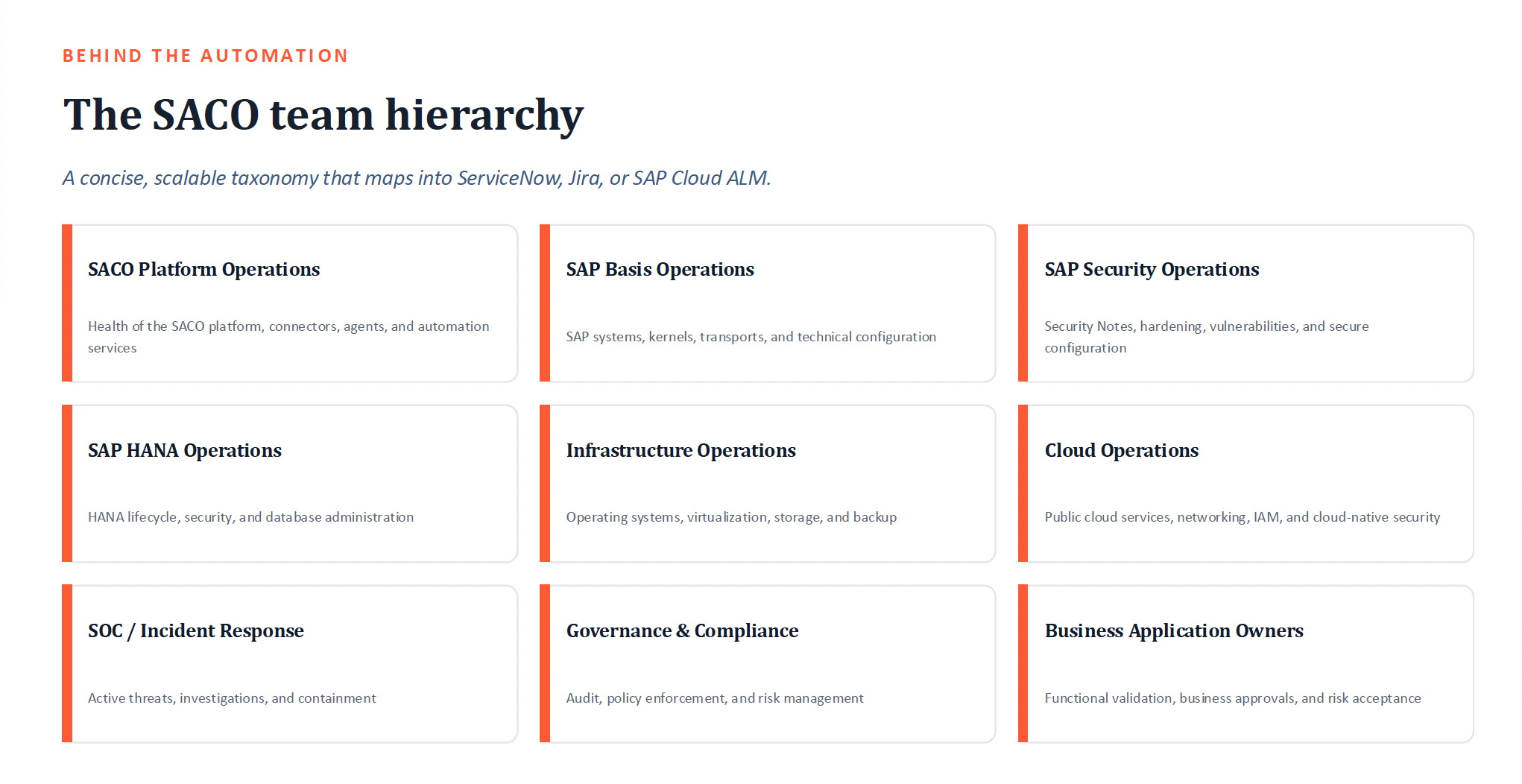
Ownership in autonomous SAP SOC should be organized by domain so every finding can be routed to the team responsible for assessing, approving, or remediating it. In the webinar, Linh outlined a SACO team hierarchy that can include SACO platform, SAP Basis, SAP Security, HANA, infrastructure, cloud, SOC and incident response, governance and compliance, and business application owners.
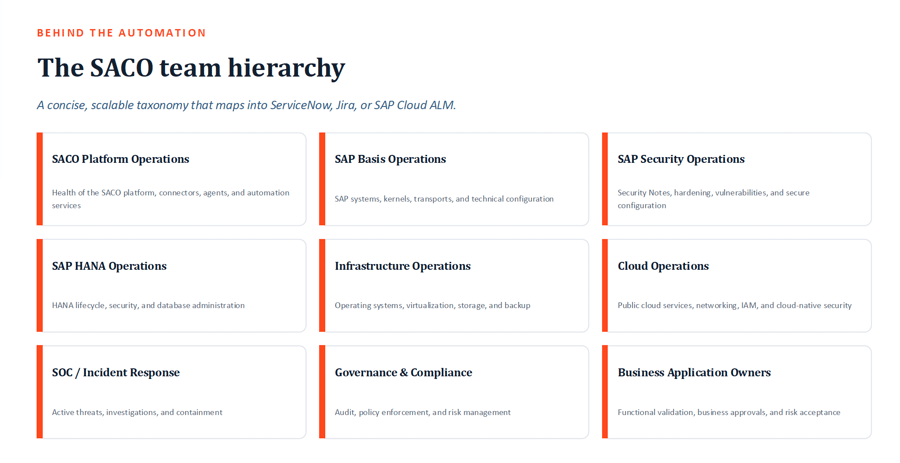 Figure 3: The SACO Team Hierarchy
Team names may vary by organization, but the principle is the same: a finding should be classified by the affected component and security area, then assigned to the owner best positioned to act. A kernel vulnerability may go to SAP Basis, a HANA issue to database operations, a weak login parameter to SAP Security, and an active exploit to SOC or incident response.
Clear ownership also makes escalation and accountability easier. Even when remediation is handled by an external provider, the organization still needs visibility into who owns the finding, its current status, whether the SLA is being met, and when the issue is fully resolved.
How does autonomous routing work?
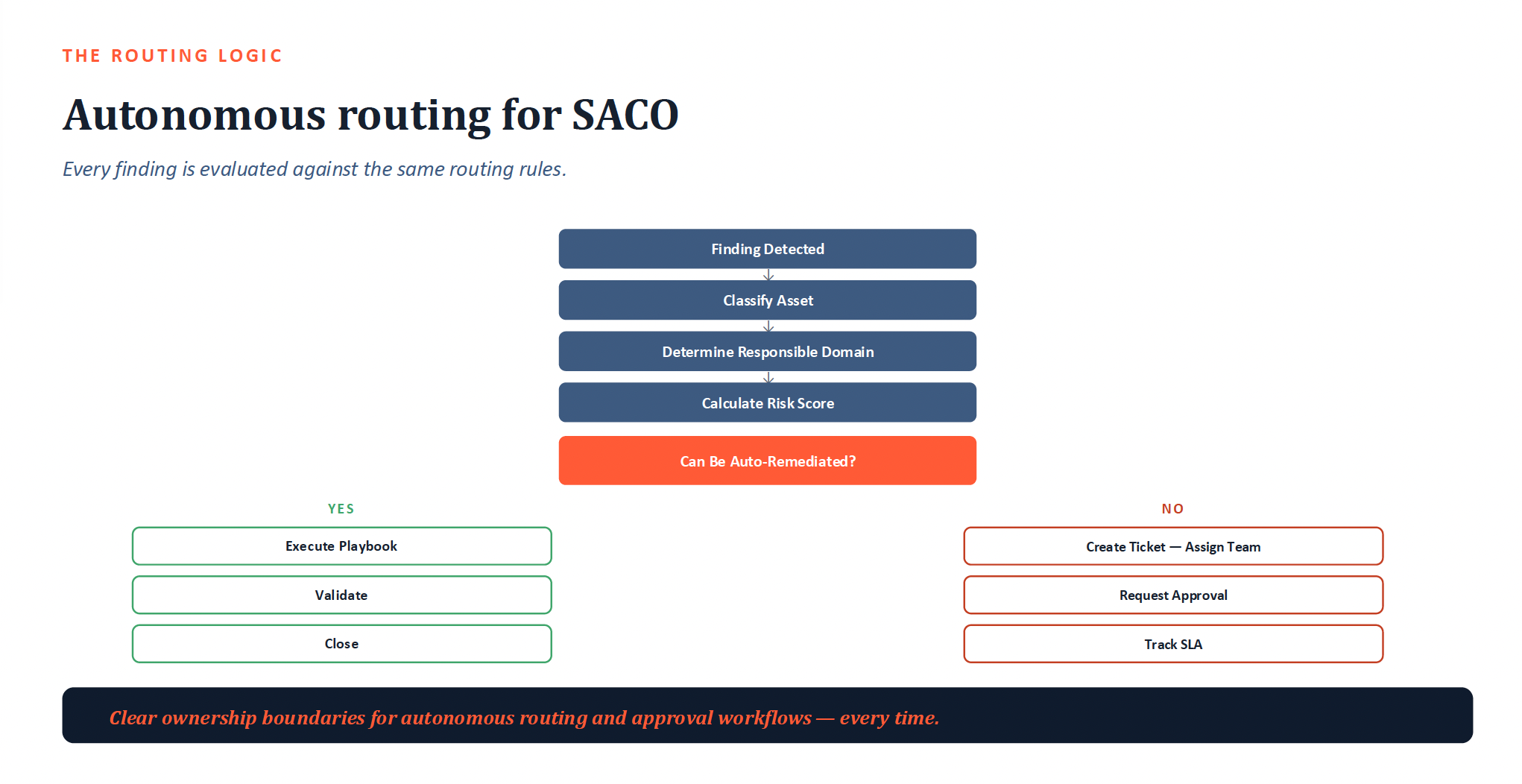
Once teams and responsibilities are defined, findings can be routed more consistently.
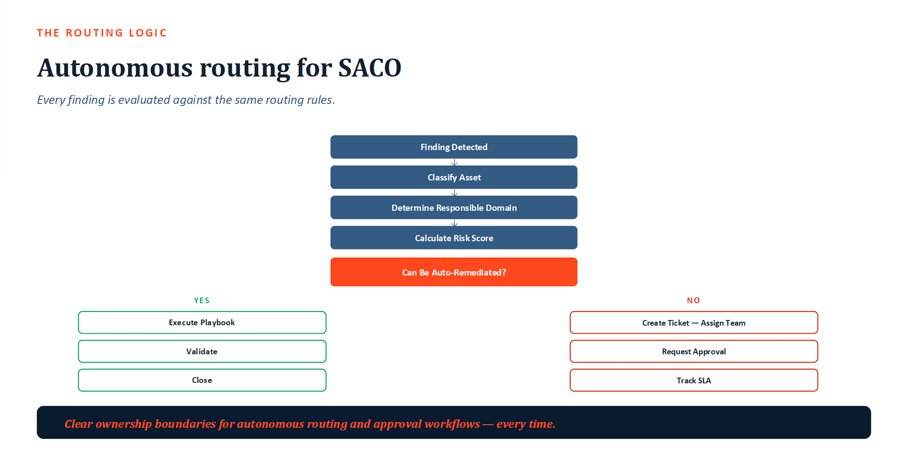 Figure 4: Autonomous Routing for SACO
IT-Conductor SecureOps first classifies the affected asset, determines the responsible domain, calculates the associated risk score, and evaluates whether the finding qualifies for automated remediation. If it does, an approved playbook can execute the action, validate the result, and close the finding. If it does not, the platform can create or route a ticket to the appropriate team, request approval where necessary, and track the SLA until the issue is addressed.
Linh also emphasized that routing should not end when a ticket is created. High-risk findings need to remain visible until they are resolved, with their age, status, and SLA tracked over time. If a finding remains open beyond its defined service level, it should trigger follow-up and escalation to the responsible team or management.
AI agents can support this process by monitoring outstanding findings, sending reminders, and escalating unresolved issues when required. This makes ticketing an active part of security operations rather than simply a record of assigned work.
Read related post: AI Agents for SAP Security Operations
IT-Conductor SecureOps platform demonstration
After outlining the roles, architecture, orchestration model, ownership, and routing needed for an Autonomous SAP Security Operations Center, Linh shifted the discussion into IT-Conductor SecureOps. The demonstration showed how those concepts come together in one platform, from security findings and risk scoring to remediation workflows, resilience tracking, and executive visibility.
How can leadership track SAP security posture and response?
Leadership needs a concise view of whether SAP security coverage is improving, where the greatest risks remain, and how quickly teams are responding. In the webinar, Linh emphasized the importance of an executive dashboard that shows the overall security score, detection coverage by environment, posture trends, and the minimum compliance baseline.
During the webinar, Linh demonstrated how IT-Conductor SecureOps brings findings into a common view, applies risk and resilience scoring across the four SACO pillars, and helps teams identify where remediation can have the greatest impact.
Start building the foundation for an autonomous SAP security operations
A strong foundation for autonomous SAP security operations starts by bringing existing tools, signals, and teams together. The goal is not to replace people with automation, but to bring people, process, and platform together through governed automation and orchestration so SOC teams can understand SAP-related risk, assign ownership, and move findings toward action.
The architecture provides the structure for that convergence. By adding a common orchestration layer across security tools, SAP systems, AI agents, routing logic, and remediation workflows, organizations can turn separate signals and decisions into a coordinated operating model with clearer context and accountability.
Clear ownership remains essential whether responsibilities sit with one small team, multiple specialized teams, an external provider, or RISE with SAP. Every finding still needs a defined owner, measurable SLA, escalation path, and centralized visibility into its progress toward resolution.
Organizations can build toward autonomy incrementally by adding SAP context and orchestration to existing security operations, then expanding governed automation over time. The strongest outcome is a SOC that can understand what a finding means for SAP, determine who should act, coordinate the right response, and verify that the risk has been addressed.