As SAP accelerates its AI-first strategy through initiatives such as the Autonomous Enterprise vision, SAP Business Technology Platform (SAP BTP) is taking on an even broader role. Beyond serving as the platform for integration, extension, automation, and analytics, SAP increasingly positions BTP as the foundation of its broader Business AI Platform (BAIP) vision, enabling organizations to build AI-powered applications, intelligent workflows, and autonomous business processes. This evolution reinforces the importance of maintaining a clean core, allowing new innovations — including AI — to be delivered without increasing complexity within SAP S/4HANA.
To address this, SAP advocates for a clean core strategy — an approach that minimizes modifications to the core ERP system and enables faster innovation. SAP BTP supports this strategy by enabling side-by-side extensions and integrations outside the ERP core. Depending on the requirement and SAP S/4HANA deployment model, organizations can also use supported in-app and on-stack extensibility options, including key-user extensibility and ABAP Cloud.
What is a clean core strategy?
A clean core refers to keeping the S/4HANA system as close to standard as possible by minimizing custom code and avoiding unnecessary modifications to the core.
This approach allows organizations to:
- Adopt new SAP innovations more quickly
- Simplify upgrades and reduce regression risks
- Lower long-term maintenance costs
- Improve system stability and performance
In contrast, traditional SAP environments often rely heavily on extensive custom ABAP code and core modifications to meet business requirements. Over time, this leads to “Z-code sprawl,” making systems harder to maintain, upgrade and modernize.
Fit-to-standard: The foundation of a clean core
A clean core strategy starts long before organizations build extensions or migrate custom code to SAP BTP. Its foundation is a fit-to-standard approach, where organizations first evaluate whether SAP's standard business processes can meet their requirements before considering custom development.
Rather than recreating legacy customizations, organizations should adopt standard SAP business processes and capabilities wherever they meet business requirements. Custom development should become the exception rather than the default, reserved for scenarios that deliver genuine business differentiation or address unique regulatory or industry-specific needs.
By prioritizing standard functionality, organizations can:
- Reduce unnecessary custom code and technical debt
- Simplify upgrades and ongoing maintenance
- Accelerate adoption of new SAP innovations and cloud releases
- Improve long-term system stability and supportability
When standard functionality is not sufficient, organizations can then choose the most appropriate extensibility option — such as key-user extensibility, developer extensibility with ABAP Cloud, or side-by-side extensions on SAP BTP — while preserving the integrity of the SAP S/4HANA core.
Challenges in achieving clean core in SAP
While the benefits are clear, achieving a clean core is not without challenges:
- Extensive legacy customizations that are deeply embedded in business processes
- Business requirements that go beyond standard SAP functionality
- Risk of disruption when removing or replacing custom logic
- Resistance to change from users accustomed to legacy workflows
Organizations need a way to retain flexibility and innovation while keeping the core system clean. This is where SAP BTP comes in.
What is SAP BTP?
SAP BTP is SAP's unified platform for application development, integration, data and analytics, artificial intelligence, and automation. As SAP advances its AI-first strategy, BTP increasingly serves as the foundation of the company's broader BAIP vision, bringing together AI services, intelligent automation, data, and application development on a common platform.
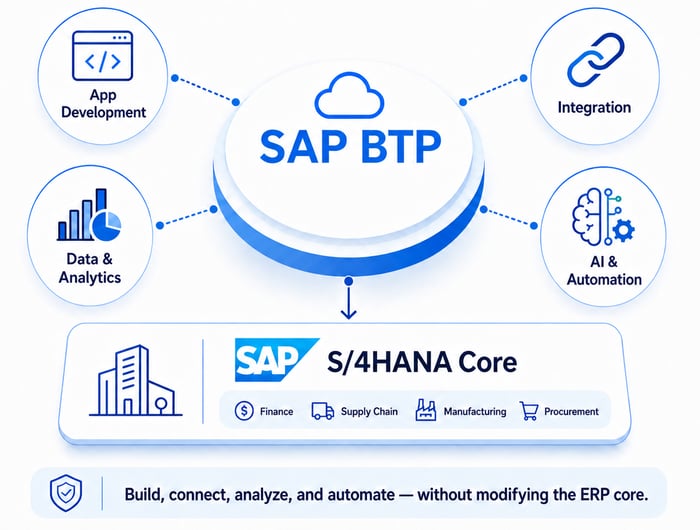 Figure 1: SAP BTP
It brings together capabilities that help organizations:
- Build and run applications using SAP BTP application development services
- Connect SAP and non-SAP systems through SAP Integration Suite
- Unify data and generate real-time insights with SAP data and analytics solutions
- Automate processes and apply AI to support faster, more intelligent decision-making
SAP BTP works alongside S/4HANA as an innovation layer, allowing organizations to build extensions, connect systems, and introduce new capabilities without modifying the ERP core.
Choosing the right extensibility model
A clean core strategy does not mean every customization should be moved to SAP BTP. Instead, organizations should choose the SAP-supported extensibility model that best fits the business requirement, business requirements, technical complexity, performance needs, and lifecycle considerations.
SAP provides several extensibility options that help preserve a clean core while enabling innovation:
- In-app extensibility (Key-User Extensibility): Allows business users to adapt SAP S/4HANA using supported tools such as custom fields, business rules, forms, and user interface adaptations without modifying the standard application.
- Developer extensibility (ABAP Cloud): Enables developers to build custom business logic within SAP S/4HANA using released APIs and the ABAP Cloud development model, helping ensure upgrade compatibility and alignment with clean core principles.
- Side-by-side extensibility (SAP BTP): Supports custom applications, integrations, workflows, automation, and AI services that run outside SAP S/4HANA while connecting through supported APIs, events, and integration services. This approach is well suited for cross-system processes, cloud-native applications, and business innovations that extend beyond the ERP system.
Selecting the appropriate extensibility model allows organizations to balance flexibility, maintainability, and innovation while keeping SAP S/4HANA easier to upgrade and support over time.
Putting clean core into practice
After adopting a fit-to-standard mindset, organizations can determine where any remaining business-specific requirements should be implemented. Rather than placing every new requirement inside SAP S/4HANA, they should choose the most appropriate SAP-supported extensibility model—whether in-app extensibility, developer extensibility with ABAP Cloud, or side-by-side extensions on SAP BTP—to preserve a clean, upgrade-ready core.
The following approaches illustrate how SAP BTP supports this strategy by enabling organizations to build extensions, integrate systems, and innovate without introducing unnecessary complexity into the ERP core.
Side-by-side extensions
SAP BTP allows organizations to build custom applications outside the S/4HANA core using a side-by-side extension model. These applications connect to S/4HANA through APIs and integration services, ensuring that business-specific requirements are met without modifying standard SAP code.
For example, companies can develop custom approval workflows, industry-specific applications, or user interfaces on BTP while keeping the ERP core untouched.
Decoupling custom code
Moving custom functionality outside S/4HANA is only one part of the clean core strategy. Organizations must also reduce tight dependencies between custom applications and S/4HANA by connecting them through SAP-supported APIs, events, and integration services rather than directly accessing or modifying internal SAP code and data.
This decoupled architecture helps prevent changes in SAP S/4HANA from disrupting custom applications, while making those applications easier to update, replace, and scale independently.
Integration without disruption
With SAP Integration Suite, BTP enables seamless connectivity across SAP and non-SAP systems through APIs, prebuilt integration content, and managed workflows. This eliminates the need for hard-coded integrations within the core system and supports hybrid environments that span cloud and on-premises systems.
Organizations can integrate CRM platforms, eCommerce systems, and third-party applications while keeping the ERP core less complex and easier to maintain.
Innovation enablement
SAP BTP provides access to advanced technologies such as AI, machine learning, and automation services that can enhance business processes outside the S/4HANA core. These capabilities can be used to automate decisions, improve workflows, and introduce intelligent applications without disrupting core ERP operations.
Simplified upgrades
A clean core significantly reduces the effort required for upgrades and system conversions. With fewer customizations in the core, organizations can adopt new S/4HANA releases faster and with lower risk.
Because side-by-side extensions are decoupled from the SAP S/4HANA core through supported APIs and services, they typically require less remediation during ERP upgrades, helping simplify lifecycle management and reduce upgrade risk.
Real-world use cases
Organizations can use SAP BTP to support clean core strategies by:
- Building custom SAP Fiori applications and user experiences outside the S/4HANA core
- Extending and automating business processes with SAP Build Process Automation
- Developing industry- or company-specific side-by-side applications
- Connecting SAP and non-SAP platforms through SAP Integration Suite
- Enabling analytics and reporting without embedding unnecessary custom logic in the ERP core
Best practices for implementing clean core with SAP BTP
Successfully implementing a clean core strategy requires more than moving custom development to SAP BTP. Organizations also need a structured approach for evaluating existing customizations, governing new extensions, and aligning technology decisions with business priorities.
Key best practices include:
- Assess existing custom code. Use tools such as the SAP Custom Code Migration app and ABAP Test Cockpit to identify obsolete, redundant, or incompatible custom objects.
- Classify customizations. Apply a “Keep, Retire, or Extend” framework to determine which custom solutions still provide value, which can be removed, and which should be redesigned using clean-core-compatible approaches.
- Establish extension governance. Define standards for architecture, security, development, integration, testing, and lifecycle management across SAP BTP.
- Align business and IT teams. Ensure stakeholders agree on transformation priorities, ownership, and the business outcomes the clean core program should support.
- Create an architecture roadmap. Plan how applications, integrations, and custom logic will be gradually decoupled from S/4HANA while supporting scalability and future upgrades.
A phased approach helps organizations reduce technical debt without disrupting critical business operations.
Read related post: Enterprise Guide to SAP S/4HANA Upgrade and Migration
Keeping SAP flexible, stable, and upgrade-ready
A clean core strategy helps organizations reduce technical debt, simplify upgrades, and create a more flexible foundation for innovation. SAP BTP supports this approach by providing a platform for side-by-side extensions, integration, automation, data, and AI capabilities outside the SAP S/4HANA core.
However, achieving a clean core requires more than adopting new technology. Organizations must also assess existing custom code, establish clear governance, use supported extensibility methods, and align business and IT teams around a long-term transformation roadmap.
By modernizing customizations gradually and keeping unnecessary complexity out of the ERP core, organizations can make SAP S/4HANA easier to maintain while preserving the flexibility needed to respond to changing business requirements.
Frequently Asked Questions